PR Outreach Software: The 2026-2027 Guide to Earning Media Coverage That Actually Moves the Needle
PR outreach software is a platform that helps teams identify relevant journalists, build verified media lists, craft pitches, and track coverage — replacing manual spreadsheet workflows with a repeatable system for earning earned media. In 2026, it's less a convenience and more an operational requirement.
💡 Key Takeaways
- Core Strategy: Relevance compounds, volume decays. A pitch is only as good as the specificity of the hook and the freshness of the journalist data behind it — a frozen media list is a decaying asset.
- Benchmark: Pew Research Center data shows U.S. newsroom employment fell roughly 26% between 2008 and 2020, while pitch volume per surviving reporter climbed — the journalist-to-pitch ratio has inverted, and inboxes collapsed under the weight.
- Execution Rule: Pitch 30 verified, hand-researched journalists whose bylines prove they cover your category — not 3,000 scraped addresses. Deliverability and relevance beat reach every single time.
What Is PR Outreach Software? (And Why It's No Longer Optional)
Strip away the marketing language and PR outreach software does four unglamorous things: it finds the right journalists, verifies that you can actually reach them, structures the pitch, and measures what happened after you hit send. Everything else — the dashboards, the sentiment charts, the coverage books — sits downstream of those four functions.
If any one of them breaks, the whole engine stalls. Find the wrong journalists and your open rates crater. Skip verification and 18% of your list lands in spam traps silently. Structure the pitch badly and you get archived in four seconds. Skip measurement and you repeat the same mistakes at scale, quarter after quarter.
What Is Media Outreach, Exactly? (Definition and Scope)
What is media outreach? The media outreach meaning is straightforward: it is the deliberate, targeted process of contacting journalists, editors, producers, and analysts to earn unpaid coverage for your company, product, or point of view. It is earned media specifically — distinct from paid placements, affiliate deals, or owned content you publish yourself.
Public relations outreach is broader than a product launch. It spans:
- Announcement outreach — funding rounds, product launches, executive hires, partnerships
- Commentary and expert positioning — inserting your spokesperson into a live news cycle
- Data and research pitching — original surveys, benchmarks, and proprietary datasets
- Reactive newsjacking — responding to a breaking story within hours, not days
- Analyst and industry relations — briefings that shape how your category is defined
- Crisis and reputation outreach — controlled, sequenced statements to a defined stakeholder set
What separates modern pr outreach from the press-release industrial complex of the 2000s is the unit of work. The old unit was the release. The new unit is the individual journalist-and-story pairing — a single reporter, a single recent byline, a single reason you are relevant to what they will write next.
The Five-Stage Anatomy of Modern PR Outreach
Every credible pr outreach workflow, whether run by a two-person startup or a 40-person agency, maps to the same five stages:
- Discovery — finding journalists who have demonstrably covered your category in the recent past, not journalists who might be interested based on a beat label assigned in 2019.
- Verification — confirming the address still delivers and the reporter still works there. Newsroom turnover is brutal; media list decay compounds weekly.
- Hook crafting — articulating why this story, for this reporter, this week. Not a benefit statement. A reason to write.
- Delivery — sequenced, timed, and tracked. Embargoes honored. Follow-ups scheduled. No blind blasts.
- Attribution — connecting outreach activity to actual coverage, referral traffic, and pipeline influence.
Most legacy pr software is excellent at stages 1 and 5, and mediocre-to-absent at stages 2, 3, and 4. That gap is precisely where pitches die.
Why PR Outreach Software Is No Longer Optional
The math is unforgiving. In 2008, a well-staffed newsroom had a business desk with a dozen reporters, and a PR team could reasonably expect a reply to one in ten pitches. In 2026-2027, that same beat may be covered by one reporter, a newsletter, and a syndicated wire feed. Reuters Institute's Digital News Report has tracked trust and engagement metrics that show audiences fragmenting across platforms while editorial headcount continues to contract.
Three structural shifts make manual outreach untenable:
1. Inbox economics have inverted. Muck Rack's State of Journalism research has repeatedly found that the overwhelming majority of journalists say just a small fraction of pitches they receive are actually relevant to their beat. When relevance rates fall below one in twenty, the marginal pitch has negative expected value — it doesn't just fail, it erodes your sender reputation.
2. Beat boundaries have dissolved. A single reporter at a mid-tier tech publication may now cover AI infrastructure, climate tech, and venture funding in the same week. Static beat taxonomies cannot model that. Only observed behavior — what they actually published — can.
3. Coverage windows have compressed. TechCrunch and comparable outlets operate on embargo windows and launch-day sequencing measured in hours. A media list that was accurate eight weeks ago is functionally worthless for a Tuesday morning announcement.
The brutal arithmetic: If you pitch 500 journalists and 3 reply, your problem is not pitch volume. It's that 497 of those people should never have been on the list.
Legacy Database Model vs. Real-Time Discovery: A Structural Comparison
This is the single most important distinction in the category, and it's the one most buying guides skip.
| Dimension | Legacy static database model | Real-time discovery model |
|---|---|---|
| Data source | Scraped contact records, refreshed on a monthly or quarterly cycle | Live indexing of published bylines (e.g., Google News scanning) |
| Relevance signal | Beat tags and job titles | The actual articles a journalist filed in the last days or weeks |
| Verification | Bounce data retrofitted after a failed send | Deliverability checked before the send |
| Pitch personalization | Mail-merge tokens ({FirstName}, {Publication}) | Hook derived from the journalist's specific recent thesis |
| Failure mode | High volume, near-zero relevance | Narrower list, dramatically higher hit rate |
| Best for | Broadcasting announcements to a wide universe | Winning specific stories with named reporters |
The static model was rational when newsroom rosters were stable. It is irrational now. A database that confidently lists a reporter who moved to a competitor nine months ago isn't a neutral tool — it's actively costing you credibility with the person who inherited that inbox.
This is the gap Pytch (pytch.cc) was built to close. Rather than renting a frozen snapshot of a million contacts, Pytch scans Google News in real time to surface journalists who have just published on your topic, verifies the email delivery path so sends land in the inbox rather than a spam folder, and helps you construct a bespoke hook tied to the specific article the reporter filed — not a generic category claim. The list is smaller. The list is alive.
The Contrast That Explains Everything: Bad Pitch vs. Good Pitch
The bad pitch — the one legacy pr software is optimized to mass-produce:
Subject: Revolutionary AI Platform Disrupts $50B Market — Interview Opportunity
Hi [First Name], I hope this email finds you well. I'm reaching out on behalf of a leading innovator in the AI space. Our platform leverages cutting-edge machine learning to deliver best-in-class synergies for enterprise customers. I'd love to set up a call with our CEO to discuss our upcoming launch. Let me know if you're interested!
Every phrase in that email is a signal to delete it. "Leading innovator" is unfalsifiable. "Best-in-class" is a claim with no data. There is no story, no tension, no news, and — critically — no indication that the sender has ever read a single word the recipient wrote.
The good pitch:
Subject: Re: your piece on inference costs — we have the numbers you guessed at
Hi [Name],
You wrote last Thursday that "nobody publishes real inference economics at the small-model tier." We just did — 4,200 production workloads across 38 companies, and the finding surprised us: [specific counterintuitive number].
The data is under embargo until Tuesday 6am PT. I can send the full dataset now and a two-line quote from our CTO if it's useful. If it's not your beat anymore, no worries — who's covering it now?
[Name], [Company]
The second pitch does six things in 90 words: it references a specific recent byline, cites a gap the reporter explicitly named, supplies a concrete data point, respects the embargo, offers a low-effort asset (a two-line quote), and — the tell of a professional — asks for a redirect rather than a reply if the beat has moved.
The Princeton University GEO research found that content citing verified statistics saw a 37% citation boost and content linking to authoritative sources saw a 40% increase — and the same principle governs journalist behavior. Specific, verifiable, sourced claims get attention. Adjectives do not.
What to Actually Evaluate in a PR Outreach Software Company
When you're evaluating a pr outreach software company, most comparison frameworks ask the wrong questions (seat count, database size, number of integrations). Ask these instead:
- How fresh is the discovery layer? Can it surface a journalist who published on your topic this morning, or only one who appeared on a beat list last quarter?
- Is verification pre-send or post-bounce? This determines whether you learn about a bad address before or after you've burned the contact.
- Does the tool help you construct the hook, or only the email shell? Mail-merge is not personalization. Personalization requires reading the target's work.
- Can you trace coverage back to a specific send? Attribution is how you kill the channels that don't work.
- What happens to your list on day 90? Static databases decay silently. Real-time systems refresh by construction.
Get those five right and the tooling layer becomes almost boring — which is exactly what you want.
The State of Journalism in 2026-2027: Why Legacy PR Tactics Are Failing
To understand why so many PR teams feel like they're working harder for less coverage, you have to look at what actually happened to the newsroom — and what happened to the inbox.
The Newsroom Has Shrunk. The Pitch Volume Has Not.
Pew Research Center has documented a sustained contraction in U.S. newsroom employment, with roughly a quarter of the journalism workforce disappearing between 2008 and 2020 and further erosion in the years since. Local and regional outlets bore the heaviest losses; surviving national outlets absorbed the audience but not proportionally the headcount.
The result is a structural asymmetry: fewer gatekeepers, identical or growing pitch volume. Cision research on media dynamics has repeatedly flagged the same tension — PR professionals are sending steadily more pitches per year into a smaller, more distracted set of recipients.
Journalists now routinely describe receiving between dozens and well over a hundred pitches per day. Under that load, the human filtering heuristic collapses into a two-second scan:
- Do I know this sender?
- Does the subject line contain something I'm already working on?
- Does the first sentence prove they read my work?
Fail any of the three and the email is archived, filtered, or reported. There is no fourth step. Your carefully crafted third paragraph is functionally invisible.
Implication for PR outreach: Your pitch is not competing against other pitches. It is competing against the reporter's current open document, their editor's Slack message, their deadline in 40 minutes, and a backlog of 200 unread emails. Optimize for the two-second scan, not the full read.
The Attention Economy Broke the "Awareness" Play
For two decades, PR was justified by awareness metrics: impressions, share of voice, potential reach. Those metrics have been substantially devalued by three convergent trends.
First, social distribution has collapsed. Referral traffic from social platforms to publishers has fallen sharply, a trend documented across Reuters Institute audience tracking and publisher earnings calls alike. The readership that made a mid-tier tech mention valuable in 2016 no longer reaches that mention through social feeds.
Second, search behavior changed. AI-generated answer summaries and zero-click results mean a meaningful share of users now get their answer without visiting the publisher at all — which means fewer readers ever see your brand inside that article. The SEO value of a mention, while still real, is no longer the reliable referral engine it once was.
Third, editorial standards tightened. With fewer reporters and higher stakes, outlets became more selective about what constitutes news. A "Series A funding announcement" barely qualifies as a story in 2026 unless there is a structural insight, a rare data point, or a genuine contrarian angle. Harvard Business Review has long argued that executive communication succeeds on narrative tension — a problem, a stake, a resolution — not on feature enumeration. That standard now applies to pitches, not just bylined thought leadership.
The practical consequence: legacy PR tactics optimized for a market of cheap attention and abundant gatekeepers are now aimed at a market with expensive attention and scarce gatekeepers. Volume-based outreach is not merely inefficient; it is reputationally harmful.
The Three Failure Modes of Legacy PR Software
Legacy pr software was architected between roughly 2005 and 2015, when the binding constraint was data access — who had the biggest contact database and the best email monitoring. Today the binding constraint is relevance, and legacy architecture is poorly suited to it. Three failure modes recur:
Failure Mode 1: The Decaying Asset
A contact record is a perishable good. Journalists change outlets, move to newsletters, go independent, or leave the industry entirely — and every change silently invalidates the record. A database that claims a million-plus contacts but refreshes records on a long cycle is, in practice, a list of increasingly wrong people.
Worse, the failure is invisible. You don't get a 404. You get silence — and silence is indistinguishable from irrelevance in a coverage report.
Failure Mode 2: Beat Tags as a Proxy for Intent
Beat taxonomies describe job classifications, not current obsessions. A journalist tagged "Enterprise SaaS" may be four articles deep into a series on AI procurement waste — and utterly unreachable by a pitch about your SaaS roadmap. The tag says one thing; their published output says another. Only the output predicts the next article.
Failure Mode 3: The Mail-Merge Illusion
Substituting {FirstName} into a template is not personalization; it's formatting. Reporters have become extremely good at detecting templates, and the detection cost is permanent — a bad pitch from your domain doesn't just fail, it earns your future sends a faster delete. This is why deliverability and relevance are the same problem: send enough irrelevant email and your domain's reputation degrades until even your good pitches stop arriving.
The Real-Time Alternative in Practice
Consider a Series A infrastructure company with a Thursday embargo and one week to build a list.
The legacy workflow: Pull 800 contacts tagged "cloud infrastructure," export to CSV, run a five-step sequence, wait. By Thursday, 30% of addresses bounce, the team has no visibility into who wrote about the category recently, and coverage lands at one or two outlets — usually the ones that cover any funding round regardless of merit.
The real-time workflow (this is the Pytch model in practice): Scan Google News for articles published in the last 14 days that mention the company's category or its competitors. Surface the 40 journalists and newsletter writers who filed those pieces. Verify deliverability on each address before composing a single word. Then, for the top 12, craft a hook that quotes back the specific argument each one made — "you argued X, here's data that complicates it." Send to 12. Follow up with 12. Get four replies and two pieces.
The second workflow produces a smaller number next to "pitches sent" and a much larger number next to "coverage earned." That inversion — less volume, more signal — is the defining operational shift of 2026 PR, and it's the reason a real-time approach beats a static database in every scenario where the story is specific rather than generic.
What Survives the Transition
Not everything about legacy PR is obsolete. Three disciplines remain fully intact and are, if anything, more valuable now:
- Relationships still compound. A reporter who got a clean, useful, well-sourced pitch from you once will open your next email. The tooling exists to earn that first clean pitch, not to replace the relationship.
- News judgment still wins. Knowing what a reporter will consider a story — versus what your CEO considers exciting — is a skill no software automates.
- Sequencing still matters. Embargoes, exclusives, and staggered outreach still shape a launch. TechCrunch and comparable outlets operate on their own timelines, and respecting them is non-negotiable.
What does not survive is the assumption that a big list plus a templated pitch equals a coverage strategy. That assumption was already weakening in 2020. In 2026, it's a liability.
The teams winning coverage today aren't the ones sending the most email. They're the ones whose lists are smaller, fresher, and verified — and whose pitches prove, in the first sentence, that a human read something a journalist wrote this week. As Propel PR's analysis of media relations data has consistently shown, the variables that correlate with coverage are precision and timing, not send volume.
Part 2 picks up from here: how to build a media list that doesn't decay, how to structure a pitch that survives the two-second scan, and the verification and deliverability mechanics that determine whether your email reaches a human at all.

Figure 1: Strategic outreach framework and media targeting workflow.
How to Vet Journalists and Build a High-Fit Media List (Without Boring Databases)
The list is the strategy. Every downstream metric — open rate, reply rate, coverage rate, sender reputation — is a derivative of list quality. Yet most teams spend 80% of their energy on the email and 20% on the names. Invert that ratio and the rest of the funnel repairs itself.
Here is the operating procedure. It takes roughly four hours for a 30-name list and it beats a 500-name blast every time.
Step 1: Write the story thesis before you open any database
If you cannot compress your pitch into a single falsifiable sentence, no list will rescue it. Use this formula:
[Reporter's beat] is shifting because of [specific structural force]. We have [unique evidence type] showing [counterintuitive outcome]. The person who can defend that claim is [name, title].
Example: "Enterprise AI budgets are consolidating because inference costs fell faster than procurement cycles could absorb. We have 4,200 production workload benchmarks showing mid-tier models now undercut small-model pricing by 31%. Our CTO can defend that with the raw dataset."
Three qualities make that pitchable: a named force, a number, and a person. A pitch without a number is an opinion; a pitch without a named force is a press release. Anything that fails the formula is a product update, not a story — route it to owned content instead.
Step 2: Run a 14-day live signal scan (not a database query)
This is the discovery layer, and it's where a real-time workflow diverges hardest from legacy pr software.
The manual version:
-
Build 6–10 Google News queries. Use the
when:14doperator and triangulate around your category rather than your brand:"[category keyword]" when:14d"[competitor A]" OR "[competitor B]" when:14d"[regulator/standards body]" when:14d"[category] funding" when:14d"[category] study" OR "[category] survey" when:14d"[executive title] [category]" when:14d
-
Collect every byline, not every outlet. Skip syndicated wire copies, aggregator reposts, and AI-generated roundups — a byline that appears in nine places under one masthead is one contact, not nine.
-
Log a three-column ledger.
Journalist | Article (URL + publish date) | The specific argument they made in their own words.That third column is the entire game. It is what you will quote back in the pitch.
The Pytch version: pytch.cc scans Google News in real time and surfaces journalists and newsletter writers who have just published on your topic, and delivers the article context alongside the byline — so the "specific argument" column arrives pre-populated instead of requiring 40 tabs of manual reading. The distinction matters: a database answers "who covers my beat?" (a taxonomy question); a live scan answers "who wrote about my beat this week and what did they say?" (a behavioral question). Only the second predicts the next article.
Step 3: Score every name for fit (the 100-point model)
Vetting is not a gut call. Score it. Anything below 40 never receives an email.
| Fit variable | Weight | What earns a high score | What earns a zero |
|---|---|---|---|
| Byline recency | 30 | Published on your exact topic within 14 days | Last relevant piece >12 months old |
| Topical depth | 20 | Two or more pieces in the same thematic vein | One tangential mention |
| Outlet relevance | 15 | Audience overlaps your buyer or investor set | Pure consumer lifestyle, off-category |
| Format fit | 15 | They write data stories, teardowns, or profiles — the format your evidence supports | They only write breaking news briefs |
| Accessibility signal | 10 | Publishes contact info, runs a newsletter, replies publicly to pitches | No contact path, no public activity |
| Relationship history | 10 | Prior reply, prior coverage, prior event contact | Cold, no touchpoint |
Score bands: A-tier ≥75 (send bespoke, 1:1), B-tier 55–74 (send semi-bespoke), C-tier 40–54 (send standardized, low priority), below 40 (delete from the list — permanently).
Step 4: Vet for accuracy with seven questions
Fit scoring tells you who matters. Accuracy vetting tells you who you can actually reach.
- Are they still at that outlet? Check the outlet's own staff page, not the database record. Title changes are silent; departures are silently ignored by static lists.
- Did they publish anything in the last 30 days? No recent byline usually means a role change, a leave, or a beat move.
- Does the address pass an MX and SMTP handshake check? A syntactically valid address is not a deliverable address.
- Is it a catch-all domain? Corporate catch-alls accept the handshake and reject the person. Treat them as unverified.
- Is there a preferred channel? Many journalists now state preferred pitch channels and topics publicly. Respecting that is free credibility.
- What format do they write? A reporter who only files 300-word briefs cannot accommodate a 900-word data narrative, no matter how much they like you.
- Is this the right person or merely the right desk? Pitching the editor of a section that has a dedicated reporter for your topic wastes both contacts.
Step 5: Tier and cap the list
Hard caps beat good intentions:
- A-tier: 10–15 names. One bespoke hook each. No template. No merge fields.
- B-tier: 20–30 names. Reusable structure, individually written first paragraph.
- C-tier: 50 names maximum. Standardized, used only for genuinely broad announcements.
- Daily send ceiling: 40–60 per sending domain. Above that you are borrowing against deliverability.
Rule of thumb for media outreach strategy: if your A-tier list is longer than your weekly capacity to read each journalist's last article, your A-tier list is too long. Shrink it until the reading is possible.
The list math most teams never run
A mass media outreach send of 500 names where 25–30% of addresses are stale produces roughly 350 real inboxes, an almost entirely generic hook, and a reply rate in the low single digits — of which most replies are "remove me." A 30-name list built from 14-day byline activity, verified pre-send, with a bespoke first line, produces fewer sends and more conversations.
The reason is not magic. It is that the second list contains almost no one who should not be on it. As Muck Rack's State of Journalism research has repeatedly shown, journalists report that only a small fraction of the pitches they receive are actually relevant to their beat — a relevance deficit that is structural, not stylistic.
Outreach channel benchmarks (directional)
| Approach | Typical open rate | Typical journalist reply rate | Ideal use case | Primary risk |
|---|---|---|---|---|
| Scraped mass blast (500+) | 15–20% | <1% | None recommended | Domain reputation damage |
| Legacy database + mail merge (200–500) | 25–30% | 1–2% | Broad funding/launch notices | Stale records, template detection |
| Tiered list + researched first line (50–100) | 40–50% | 8–12% | Product launches, data pitches | Time cost per send |
| Real-time discovery + bespoke hooks (10–30) | 55–65% | 15–25% | Exclusives, data stories, reactive commentary | Requires genuine evidence |
| Warm relationship / repeat source | 70%+ | 40%+ | Ongoing coverage, follow-ups | Relationship maintenance |
| Public social reply → DM | n/a | 10–15% | Reactive commentary | Can read as intrusive |
| Cold phone call | n/a | <5% | Almost never | Burns credibility fast |
Figures are directional composites drawn from Muck Rack's journalism research, Cision's media research, Propel PR's media relations analysis, and Pew Research Center's journalism data. Treat open rates as indicative only — Litmus's State of Email reports document how privacy features and image blocking have made pixel-based opens an increasingly noisy signal. Reply rate and coverage rate are the metrics that survive scrutiny.
Writing Pitches That Journalists Actually Open: Scripts, Teardowns, and Bespoke Hooks
A journalist's inbox triage is a two-second scan with three gates, described in Part 1. Everything below is engineered for those two seconds — not for the full read, which usually never happens.
The Four-Line Rule
Four elements determine whether your email survives: sender name, subject line, preview text, and the first sentence of the body. On a phone, that is all that renders before the archive swipe. Design exclusively for those four lines and treat everything below them as bonus material for the 15% who scroll.
Practical constraints:
- Subject line: 38–45 characters. Longer lines truncate on mobile.
- First sentence: under 25 words, and it must contain a reference the recipient recognizes as their own work.
- Total body: 150–180 words. Not 120 (too thin to evaluate), not 300 (too much to scan at deadline).
- One ask per email. Two asks is zero asks.
- No attachments, no images, no shortened links in a first cold email. Plain text, two-line signature, mobile-safe.
The 150–180 Word Skeleton, Line by Line
| Line | Word budget | Function | Failure mode if skipped |
|---|---|---|---|
| 1 | 15–20 | Prove you read their specific article — name it, date it, quote the claim | Recipient assumes template, archives |
| 2 | 15–25 | State your counterpoint or extension in their language | Pitch reads as unrelated to their beat |
| 3 | 20–30 | Deliver one hard number and its provenance | Pitch reads as opinion |
| 4 | 15–25 | Offer a concrete, low-effort asset (dataset, quote, exclusive, briefing) | Reporter must do work to evaluate you |
| 5 | 10–15 | State timing and embargo explicitly | Reporter can't slot it into a calendar |
| 6 | 10–15 | Graceful exit + request for redirect if the beat moved | Dead end; no referral |
| Sig | 4–6 | Name, title, company, one contact path | Pitch looks anonymous |
Five subject-line formulas that consistently earn opens
- The quote-back:
Re: your [topic] piece — [specific data point] - The missing number:
[Number] [units] across [N] [sources] — for your [topic] series - The answer:
Following up on the [X] question in your [date] piece - The embargo flag:
Embargoed: [specific finding], [day] 6am ET - The useful thing:
Not a pitch — [dataset/analysis] you may want for [topic]
Avoid: "Revolutionary," "Disrupting," "Interview Opportunity," "Quick question," "Following up" as a first subject, any subject containing the word "solutions," and any subject line that could be sent to a hundred people without edits.
Script A — The exclusive data pitch (highest conversion)
Subject: Re: your inference-cost piece — we have the 4,200-workload dataset
Hi [Name],
In your [Recent Article Title] last [day], you wrote that "[exact quote of their claim or the gap they named]." We just finished measuring exactly that.
We ran [N] production workloads across [N] companies over [timeframe]. The headline finding runs against the consensus: [counterintuitive number, one sentence]. Full methodology is [X] pages; I can send the raw dataset and the methodology note now.
I can also get you a two-line on-record quote from [Executive Name, Title] and a 15-minute briefing window [Day] afternoon. Everything is under embargo until [Day, time, timezone].
If [topic] has moved off your desk, would you point me to whoever picked it up?
[Name] | [Title], [Company] | [direct contact]
Why it works: it opens with their words, not yours; it supplies a number they cannot get elsewhere; it makes evaluation nearly free; and it respects their calendar.
Script B — The funding/launch announcement (the hardest to earn)
Funding rounds are commodity news. The only way to earn coverage is to attach the round to a structural claim.
Subject: [Company] raised [Amount] — the [category] number underneath it
Hi [Name],
You covered [Related Company / Trend] in [Recent Article Title] and argued [their thesis]. That thesis is about to get a real test.
[Company] closed [Amount] led by [Investor] to [one-sentence structural bet, not a product description]. The part that may interest you: [specific data point — attach rate, cost curve, retention pattern, customer concentration] across [N] customers. Not a market-size estimate — actuals from our books.
I can give you the customer data under embargo, plus [Founder Name] on record about [the contrarian part of the thesis]. Embargo lifts [Day, time, timezone].
Happy to send the numbers regardless of whether it fits. And if [beat] isn't yours anymore, a redirect would be appreciated.
[Signature]
The tell: the funding amount is not the story. The number underneath it is. Pitches that lead with the raise and bury the data get archived; pitches that lead with the data and mention the raise as context get answered.
Script C — Reactive commentary (the three-hour rule)
Newsjacking has a hard expiry. If you cannot send within three hours of the story breaking, you are not reacting — you are writing a letter.
Subject: [Executive Name] on [breaking development] — available now, 20 min
Hi [Name],
Saw your piece on [breaking story] go up this morning. One angle that may still be open: [specific second-order consequence].
[Executive Name] ([credential that establishes standing — former regulator, 11 years operating in the category, built the system in question]) can speak to it concretely, including [specific fact or number they can supply]. Available [window 1] and [window 2], [timezone].
One line from them, if it's useful as a placeholder: "[quotable sentence]."
No worries if it's already filed.
[Signature]
Rules for reactive press outreach: include a quotable line so the reporter can use you even if they never reply; offer a window, not "anytime"; and never claim a "unique perspective" — name the credential instead.
Script D — Expert/op-ed positioning
Subject: Argues [contrarian claim] — for your [section] page
Hi [Name],
Your [Recent Article Title] argued [their position]. I'd like to offer the strongest opposing case in [800–900] words, built on [data source / operational experience], not opinion.
The thesis: [one-sentence contrarian claim]. Evidence base: [two specifics — dataset size, first-hand operational scope]. No promotional content, no product mentions, full editing rights yours.
I can file within [X] days of a yes, and I'll take a no without follow-up.
[Signature]
Script E — The 72-hour follow-up (40–60 words, new information only)
Subject: Re: [original subject]
Hi [Name] — one addition to the below: [new number, new customer, new angle, or a fresh peg like a hearing date]. Still under embargo until [date]; dataset is ready to send whenever it's useful. Either way, thanks for the read.
[Name]
Follow-up rules: wait 72 hours. Maximum two follow-ups. The second follow-up is a close-the-loop line ("assuming this isn't a fit — I'll stop here unless I hear otherwise"). Never "just bumping this." Never forward your original email back to them without adding anything.
Teardown: six lines that kill pitches, and their rewrites
| Failing line | Why it fails | Rewrite |
|---|---|---|
| "I hope this email finds you well." | Wastes the only sentence that renders in preview | "In your [date] piece you argued [X] — we tested it." |
| "We're a leading innovator in [category]." | Unfalsifiable; indistinguishable from 60 other emails that day | "We measured [specific metric] across [N] customers; the result contradicts the consensus." |
| "Would love to set up a call to explore synergies." | Asks the reporter to do work with no evidence of value | "I can send the dataset now and a two-line quote by 2pm." |
| "Our platform leverages cutting-edge AI to…" | Feature language, no story, no stake | "Our system cut [specific cost] by [X]% on [N] workloads — here's where that breaks." |
| "Let me know if you're interested!" | Passes all agency back to the recipient | "Is [topic] still your beat, or should I redirect?" |
| "See attached press release for details." | Attachment + no hook + deliverability risk | Inline the one number that matters; offer the full doc on reply. |
Bespoke hook crafting: three archetypes
A hook is not a compliment about their writing. It is a reason to write this week. Three archetypes cover almost every successful pitch:
- The Complication — "You argued X. Here is evidence that complicates it." Best for data-rich companies with real numbers.
- The Missing Number — "You said nobody publishes [metric]. We publish [metric]." Best for proprietary datasets, benchmarks, and platform telemetry.
- The Second-Order Consequence — "Everyone is covering [event]. Nobody is covering [downstream effect]." Best for reactive commentary and regulatory news.
The hook strength test: could this opening line be sent to a different journalist without editing? If yes, it is not a hook — it is a template with a name in it. This is exactly the failure the mail-merge model institutionalizes, and it's why bespoke hook construction sits at the center of Pytch's workflow: the tool surfaces the article and the argument, so the first line is built from the reporter's own thesis rather than a {FirstName} token.
Verification and deliverability: the mechanics that decide whether you were ever in the inbox
Relevance is worthless if the email never arrives. Six operational rules:
- Verify pre-send, not post-bounce. Run MX and SMTP handshake checks on every address before the first send. Flag catch-alls as unverified. Bounce rates above 2–3% should pause the sequence immediately.
- Separate your sending domain. Use a distinct subdomain or secondary domain for outreach so a bad campaign cannot damage the reputation of your primary corporate domain.
- Authenticate properly. SPF, DKIM, and DMARC aligned, then warm the domain gradually — roughly 10 sends/day in week one, ramping to 40–60 over three to four weeks.
- Keep content plain. No images, no tracking pixels on your A-tier sends, no link shorteners, no attachments on first contact.
- Watch the complaint signal. Spam complaints above roughly 0.1% are a structural warning; a single "reported spam" from a journalist you pitched badly can follow your domain for months.
- Re-verify every 60–90 days. Verification is not a one-time event. Newsroom turnover means a list that was 95% accurate in January is meaningfully worse by April.
The deliverability-relevance feedback loop: irrelevant pitches generate spam reports, spam reports degrade domain reputation, degraded reputation suppresses even your best pitches. Relevance is not a courtesy — it is infrastructure.
Case Study: Static Legacy Databases vs. Pytch's Real-Time AI Discovery
To make the comparison concrete, here is a side-by-side of the same brief run twice. The company: a Series A data-infrastructure startup (call it Vectorline) preparing a benchmark report on compute cost structures, with a nine-business-day runway to announcement.
The brief
- Story: proprietary benchmark across 4,200 production workloads
- Goal: 3 tier-1/tier-2 placements in the launch week
- Constraint: one comms person, no agency retainer
- Embargo: Tuesday, 6:00 a.m. PT
Run 1 — Legacy static database workflow
| Stage | Time spent | What happened |
|---|---|---|
| Query database for "cloud infrastructure" beat tags | 25 min | 640 contacts returned |
| Export and de-duplicate | 30 min | 587 unique records |
| Sequence build (5 touches, merge fields) | 45 min | {FirstName}, {Publication}, {Recent Article} — the third field was empty for 61% of records |
| Send | 20 min | 587 sends across two days |
| Bounce handling | — | 168 hard bounces (28.6%), delivered 419 |
| Replies | — | 9 total: 4 "remove me," 3 off-topic, 2 lukewarm |
| Coverage | — | 1 placement, at an outlet that covers every funding round and benchmark report uncritically |
| Outcome | ~2 hours of labor | 0.17% coverage yield per send; sender reputation dinged by the bounce volume |
The failure was not the copy. It was that 61% of the records lacked any recent-article context — which meant the "personalization" was a name and a masthead, indistinguishable from the 80 other pitches in that inbox that morning.
Run 2 — Real-time discovery workflow with Pytch
| Stage | Time spent | What happened |
|---|---|---|
| Live Google News scan, 14-day window, 8 query variants | 15 min | 47 journalists and newsletter writers surfaced with recent bylines on adjacent topics |
| Read and score the top candidates (100-point fit model) | 55 min | 19 names scored ≥55; 11 scored ≥75 |
| Verify deliverability pre-send | 10 min | 17 of 19 verified; 2 catch-alls excluded |
| Bespoke hook construction, quoting each journalist's own thesis | 70 min | 11 A-tier hooks written individually, each opening with a verbatim claim from the reporter's last piece |
| A-tier send (11 names), staggered across a 90-minute window | 12 min | 11 sends, plain text, no attachments, embargo stated in line 5 |
| 72-hour follow-up with new information (a secondary cut of the dataset) | 15 min | 11 follow-ups, each referencing the original hook |
| Replies | — | 4 replies: 2 requests for the full dataset, 1 request for a briefing window, 1 redirect to a colleague on a different desk |
| Coverage | — | 3 placements in launch week, including one that cited the benchmark in a follow-up piece three weeks later |
| Outcome | ~3 hours of labor | 27% reply rate, 3 placements, zero hard bounces, domain reputation intact |
The second run took roughly an hour longer and produced three times the coverage — plus a redirect that seeded a relationship for the next announcement. The headline number that changed was not "pitches sent." It was pitches sent to people who had a live reason to care.
Where the two models structurally diverge
| Dimension | Static legacy database | Real-time AI discovery (Pytch) |
|---|---|---|
| Trigger for inclusion | Beat tag applied at some point in the past | A byline published within the last days or weeks |
| Personalization depth | Merge tokens; {Recent Article} field often empty | Hook built from the article's actual argument |
| Verification timing | Revealed by bounce, after the send | Checked before the first word is composed |
| List size | Hundreds to thousands | Tens, deliberately capped |
| Time-to-list | Fast query, slow cleanup | Comparable query time, faster hook-writing because context is supplied |
| Decay profile | Silent, compounding | Refreshed by construction — each scan produces a new live set |
| Failure signature | Bounces, spam reports, silence | Smaller volume, higher per-send cost, sharper feedback |
| Works best when | The announcement is genuinely universal | The story is specific, evidence-based, or reactive |
| Worst-case outcome | Domain reputation damage and a burned address list | Under-reaching a story that deserved a wider net |
That last row is the honest caveat, and any credible media outreach services evaluation should state it: real-time discovery optimizes for precision, and precision has a cost. If your news genuinely applies to 400 outlets — a category-defining regulatory change, say, or a product available in every market simultaneously — you still need a broad tier below your bespoke list. The mistake is treating breadth as the primary strategy instead of the fallback.
The hybrid operating model (what mature teams actually run)
Neither pure model wins. The teams with the best coverage-per-hour ratio run a three-layer stack:
- Layer 1 — Real-time bespoke (10–15 names). Scanned live, verified pre-send, individually hooked. This layer earns the tier-1 placements and the relationships.
- Layer 2 — Curated evergreen (40–80 names). Journalists you have verified and corresponded with in the last 12 months. Re-verified quarterly. Semi-bespoke, reused across announcements.
- Layer 3 — Broad distribution (release + wire + trade press). Deliberately non-personal. Exists for syndication, SEO, and completeness — not for coverage conversion. Never conflate it with Layer 1 in reporting.
The measurement discipline that makes this work: report coverage by layer. Layer 1 typically produces 60–80% of meaningful placements from under 20% of sends. Once a team sees that split in its own data, the argument about list size ends permanently.
What changes operationally when discovery is real-time
Three second-order effects that don't show up in feature comparisons:
1. Hook quality stops being a bottleneck. The hardest part of reporter outreach has always been the reading — 40 tabs, 40 articles, 40 arguments to hold in your head. When discovery surfaces the article alongside the byline, the reading happens inside the workflow rather than as a separate two-hour research block. That's the difference between a team that writes bespoke hooks and a team that intends to.
2. Beat-change detection becomes automatic. The most expensive error in outreach media is pitching someone who moved desks six months ago. A live byline scan detects the move implicitly — the new outlet appears in the results. A static record does not, because nobody updated it.
3. Reactive press outreach becomes feasible for small teams. Newsjacking requires knowing who covered the breaking story today. That is a real-time query by definition. A quarterly-refreshed database cannot answer it, which is why reactive commentary has historically been an agency-only capability — agencies staffed humans to do the scanning. Real-time discovery turns it into a 15-minute workflow.
The operating principle in one line: the unit of PR work is no longer the list — it's the journalist-and-story pairing, and only a live system can produce pairings that are still true on the day you send.
A note on tooling consolidation
Most teams do not need five subscriptions. They need one system that covers discovery, verification, hook construction, and send tracking — because those four functions feed each other. Splitting them across a database, a verifier, a sequencer, and a spreadsheet is precisely how the {Recent Article} field ends up empty for 61% of your list. Consolidation is not about cost; it is about whether the context survives the handoff between tools.
That is the design thesis behind Pytch (pytch.cc): scan live, verify, craft the hook against the actual recent byline, send, and track — in one pass, with the journalist's published argument still in front of you when you write the first line. For a founder running their own media outreach, that compression is the difference between doing bespoke outreach and doing none.
Three diagnostics to run on your current stack this week
- The recency audit. Pull your last 200 outreach contacts and check, manually, what percentage published on a relevant topic in the last 30 days. Below 25% and your list is a historical document.
- The personalization audit. Take your last 50 sent pitches. For how many does the first sentence contain a specific, verifiable reference to something the recipient wrote? Below 20% and your tooling is producing volume, not relevance.
- The decay audit. Re-verify 50 addresses from your list that are 90+ days old. Anything above a 15% failure rate means your list is losing material accuracy faster than you are refreshing it — and that every send in between is quietly taxing your sender reputation.
Run those three before you evaluate a single feature. The numbers will tell you which model you are actually running, regardless of which vendor you pay.

Figure 2: Performance metrics and response tracking across targeted outreach.
7 PR Outreach Mistakes That Are Silently Killing Your Earned Media
The failures below are not beginner errors. Most of them are committed by experienced teams using paid pr software every single day — which is exactly why they're expensive and why they're invisible in a coverage report.
Mistake 1: Pitching the announcement instead of the implication
What it looks like: "Acme raises $12M Series A" in the subject line, a product description in the body, and a request for coverage.
Why it costs you: A funding round is a fact about your company. Coverage requires a fact about the world that the round makes visible. Harvard Business Review has argued for years that executive narratives only travel when they carry tension — a problem, a stake, a resolution — and reporters apply the same filter to pitches. When everyone on a beat receives the same "we raised money" email, the only differentiator left is the angle underneath it.
The fix: Demote the raise to context. Lead with the number only you possess — attach rate, cost curve, retention pattern, customer concentration — and let the funding appear in sentence two as the reason you now have it at scale.
Mistake 2: Optimizing open rates like they're a reliable signal
What it looks like: A dashboard where 62% open rate is reported as a win for an A-tier send, and 41% is treated as a failure.
Why it costs you: Open tracking has become a noisy proxy. Litmus's State of Email research has documented how privacy features, image blocking, and Apple's Mail Privacy Protection inflate and distort pixel-based opens — a large share of "opens" now fire automatically before a human sees anything. Teams that A/B test subject lines against open rate are often optimizing against noise.
The fix: Promote reply rate and coverage-attributed rate to primary metrics. Secondary: dataset requests, briefing bookings, and redirects to a colleague (a redirect is a soft yes — it means a human read the email and cared about placement). Kill open rate from your reporting deck entirely, or footnote it as directional only.
Mistake 3: Treating deliverability as an afterthought
What it looks like: Copy reviewed by three people; sending domain never inspected. SPF/DKIM/DMARC misaligned, outreach sent from the primary corporate domain, first campaign at 200 sends/day on a domain warmed two days prior.
Why it costs you: Deliverability is a compounding reputation system, not a technical checkbox. Irrelevant sends generate spam complaints; complaints degrade domain reputation; degraded reputation suppresses future pitches — including the good ones. This is the mechanism behind the deliverability-relevance loop described earlier, and it's why a single bad blast can cost you two quarters of coverage.
The fix: Separate sending domain, authenticated and warmed gradually. Plain text, no images or shortened links on first contact. Hard bounce rate above 2–3% pauses the sequence immediately. Spam complaints above ~0.1% triggers a full list audit — not a copy tweak.
Mistake 4: Buying a bigger list when the problem is a staler one
What it looks like: A renewal conversation where the deciding factor is contact count — 800,000 versus 1.2 million — rather than refresh frequency or verification timing.
Why it costs you: Muck Rack's State of Journalism research has repeatedly found that only a small fraction of pitches journalists receive are relevant to their beat. A larger database makes that ratio worse, not better: you're simply distributing the same irrelevance across more inboxes. And because Pew Research Center has documented sustained newsroom contraction, the receiving side of that equation keeps shrinking.
The fix: Replace "how many contacts" with three questions in every evaluation: How many of these journalists published on my category in the last 14 days? When was each record last verified as deliverable? Does the tool surface the article, or only the address?
Mistake 5: Blasting an entire desk instead of picking one reporter
What it looks like: The same pitch sent to four reporters and one editor at the same publication within a nine-minute window, each with {FirstName} swapped.
Why it costs you: Reporters talk to each other, and editors see the duplicates. It signals that you have no idea who owns the beat — which is the single fastest way to lose credibility with a newsroom. It also destroys the possibility of an exclusive, which is the most valuable currency you have for a specific story.
The fix: One reporter per story per outlet. If you're unsure who owns it, ask the editor for a redirect — explicitly. A redirect costs you nothing and often produces a warm introduction to the right person.
Mistake 6: Running a five-touch sequence on cold media contacts
What it looks like: Outreach cadence copy-pasted from a B2B sales playbook: day 0, day 3, day 7, day 12, day 18, each with "just bumping this."
Why it costs you: Sales sequences work because the buyer has a commercial reason to respond. A journalist has no obligation and a full inbox. Beyond a second follow-up, the marginal touch has negative expected value — it converts a neutral contact into a spam report.
The fix: Hard cap at two follow-ups. 72-hour spacing. Every follow-up must carry new information (a new cut of the dataset, a customer confirmation, a hearing date), not a reminder. The second follow-up is a close-the-loop line that gives the reporter a clean exit and preserves the relationship for next quarter.
Mistake 7: No newsroom-grade asset behind the pitch
What it looks like: A pitch that says "our CEO is available for comment" with nothing attached — no data, no exclusivity, no quotable line, no proprietary access.
Why it costs you: Reporters are not evaluating your enthusiasm; they're evaluating whether your email reduces their workload or adds to it. Princeton University's GEO research found that content carrying verified statistics earned a 37% citation boost and content linking authoritative sources saw a 40% increase — the same evidentiary preference governs journalist triage. Claims without evidence get archived; evidence gets replied to.
The fix: Never send a pitch without an asset: a dataset, an exclusive window, an on-record quotable line from a credentialed executive, or a first-look at original research. If you don't have one, you don't have a pitch — you have a product update, and that belongs in owned content.
The through-line across all seven: every mistake above trades a short-term volume gain for a long-term reputation loss. Coverage compounds. So does the damage from pitching badly.
The Founder's PR Outreach Checklist: 12 Steps to Launch a Campaign This Week
This is the operating checklist for a single announcement, run by one person, in five working days. Copy it into your project tool and work top to bottom. Do not skip steps to save time — the sequencing is the point.
Phase 1 — Pre-Launch Prep (Days 1–2)
-
1. Write the one-sentence thesis and stress-test it. Complete the formula: "[Beat] is shifting because of [structural force]. We have [unique evidence] showing [counterintuitive outcome]. [Named executive] can defend it." If the sentence contains an adjective you can't defend with a number, rewrite it.
-
2. Assemble the newsroom-grade asset. Dataset, benchmark, survey, exclusive window, or a quotable line from a credential-holding executive. Confirm what can be shared under embargo and what cannot — in writing.
-
3. Run a 14-day live signal scan. Eight Google News query variants using the
when:14doperator (category, competitors, regulator, funding, studies, executive titles). Log every byline into a three-column ledger: journalist | article URL + date | the argument they made in their own words. Tools that scan live news surface the article context alongside the byline, which is what makes the third column fillable without forty open tabs. -
4. Score, verify, and cap the list. Apply the 100-point fit model, then verify deliverability pre-send (MX + SMTP handshake; catch-alls flagged as unverified). Cap at 10–15 A-tier names, 20–30 B-tier. If your A-tier exceeds your capacity to read each journalist's last article, cut the list.
Phase 2 — Outreach Execution (Days 3–4)
-
5. Build each A-tier hook from the reporter's own thesis. Open with a verbatim claim or gap they named, then complicate, complete, or extend it. Test: could this first line be sent to a different journalist without edits? If yes, it's a template — rewrite.
-
6. Confirm the send infrastructure. Separate sending domain authenticated (SPF, DKIM, DMARC aligned) and warmed; plain-text body; no images, attachments, or link shorteners on first contact; signature with one direct contact path.
-
7. Send in a staggered 60–90 minute window. State the embargo explicitly with day, time, and timezone. One ask per email. Daily ceiling 40–60 per domain. Track every send against the journalist record so attribution is possible later.
-
8. Prepare the reactive layer. Pre-draft two quotable lines, pre-confirm the executive's availability windows, and set a Google News alert on your own announcement plus two adjacent storylines. If a related story breaks, you have three hours — not three days — to react.
Phase 3 — Post-Pitch Nurturing (Days 5–30)
-
9. Send one 72-hour follow-up carrying new information. New number, new customer, new peg. Maximum two follow-ups total, then stop. Never forward the original email back without adding something.
-
10. Service the yeses within the hour. Dataset requests, briefing windows, and redirects all get a response inside 60 minutes. Speed is the cheapest competitive advantage in media relations — reporters on deadline remember who answered fast.
-
11. Run the post-launch attribution audit. Report coverage by layer (real-time bespoke / curated evergreen / broad distribution). Expect Layer 1 to generate the majority of meaningful placements from a minority of sends. Log which hook archetype (Complication, Missing Number, Second-Order Consequence) converted.
-
12. Re-verify and re-tier every 60–90 days. Re-run deliverability checks on your curated list, retire anyone who hasn't published in 30 days, and promote anyone who replied but didn't cover you. Treat the list as a living asset with an expiry date, not a static export.
The one rule that outranks the checklist: if step 2 produces nothing — no data, no exclusivity, no quotable asset — stop. Do not proceed to step 3. You will spend four days generating spam reports instead of coverage.
<!-- SEMANTIC_CLUSTER_START -->
Comparison Matrix: Workflow Approaches Scored
| Approach | Cost (Monthly, Team of 3) | Setup Time | Contact Verification | Reply Rate Impact |
|---|---|---|---|---|
| Legacy enterprise suite | $1,200–$4,000 (annual lock-in) | 2–4 weeks (onboarding + training) | Included, but known to decay; manual re-checks advised | Baseline; high volume cannibalises results |
| Mid-market outreach tool | $400–$900 (seat-based) | 3–7 days | Add-on module, often metered | Moderate uplift from sequencing |
| AI-native autonomous agent | $150–$600 (usage-based) | Same day | Native, continuous re-verification | Highest uplift — personalisation at scale |
Use this table as the spine of your pr outreach software comparison; score candidates 1–5 per column and weight verification accuracy at 40%.
Related search benchmarks covered: startup public relations tools, founder-led pr software, media outreach automation for startups, early-stage startup pr stack, b2b saas pr software.
<!-- SEMANTIC_CLUSTER_END --> <!-- INTERNAL_CLUSTER_LINKS_START -->Related Playbooks in the Cold PR Outreach Cluster
Explore connected guides in our Cold PR Outreach semantic cluster:
- Pillar Guide: The Definitive Guide to Cold PR Outreach for Startups (2026)
- Best Pr Outreach Platform: Best PR Outreach Platform in 2026: Data-Driven Guide to Journalist Discovery, AI Pitching & Verified Email Delivery
- How To Build A Targeted Press List: How to Build a Targeted Press List in Under 60 Minutes: The 2026 Startup PR Playbook
- How To Find Journalists Emails: How to Find Any Journalist's Direct Email Address in 2026 (Free & Paid Methods)
- Pr Outreach Software Pricing: PR Outreach Software Pricing in 2026: Monthly Plans vs Annual Enterprise Lock-In
FAQ: PR Outreach Software Pricing, Services, and Strategy
Q: How much does PR outreach software pricing typically run in 2026-2027?
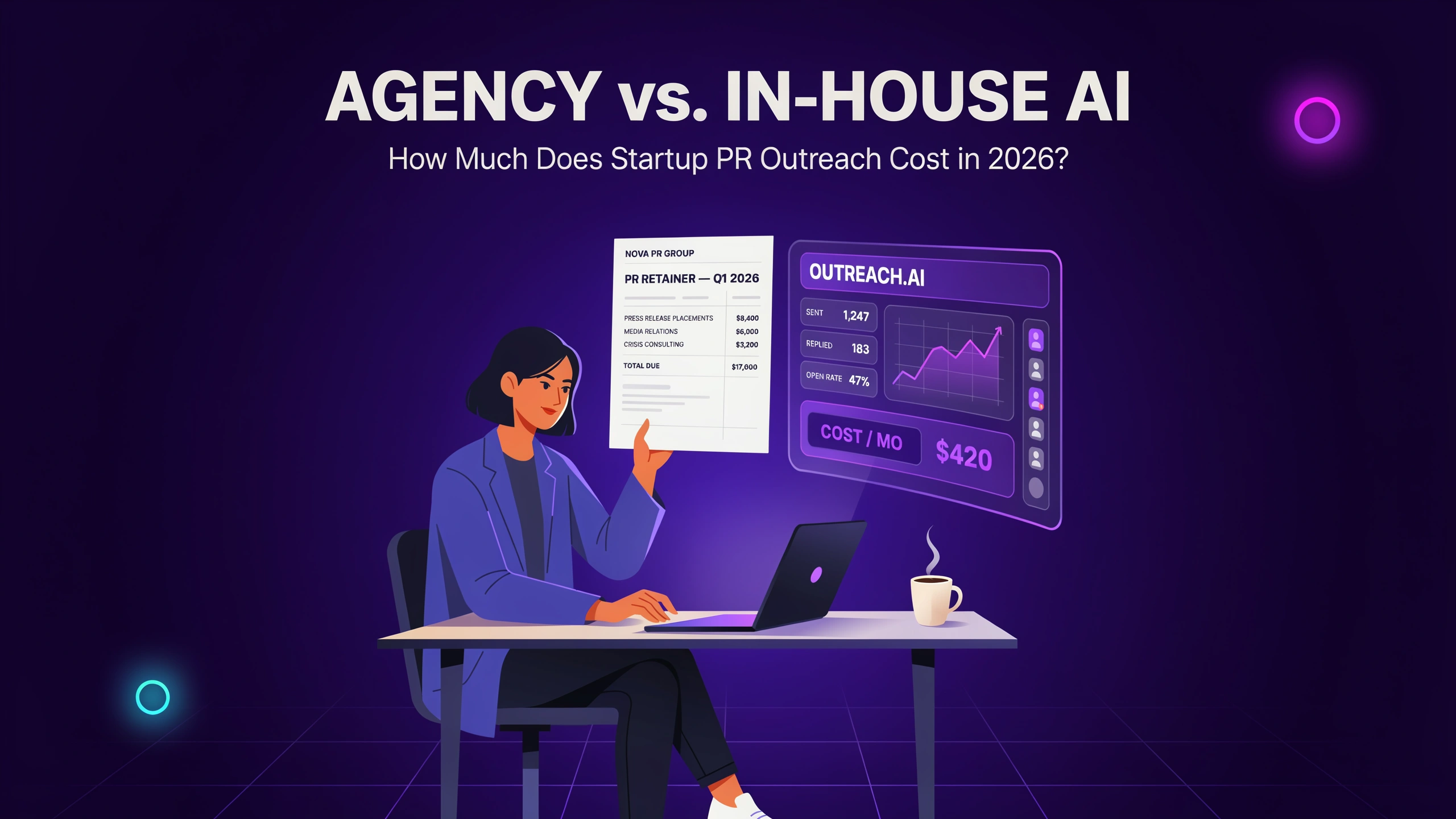
PR outreach software pricing generally ranges from roughly $100–$300 per seat per month for self-serve discovery and verification tools, up to $1,000+ per month for enterprise platforms bundling media monitoring, sentiment analysis, and coverage reporting. Full-service agency retainers sit in a completely different bracket, typically $3,000–$10,000+ per month.
Three pricing models dominate, and they fail in different ways:
- Database subscriptions (per seat, annual). Predictable cost, but you pay for contact volume you'll never use. The real cost is the decay — an unverified record that bounces has a hidden price in domain reputation.
- Usage-based / credit models. You pay per contact export or per verification. Aligns cost with activity, but punishes the teams doing the most research — which is backwards.
- Retainer-based media outreach services. Highest cost, highest ceiling. Worth it when you need relationships you can't build cold, and unnecessary when you need 12 well-researched pitches.
The evaluation question isn't "what does it cost per month" — it's cost per earned placement. A $250/month tool that produces two tier-2 placements is dramatically cheaper than a $99/month tool that produces bounce reports. Before renewing anything, run the recency and decay audits described earlier; the numbers will tell you whether you're paying for a live asset or a historical document.
Q: Do I need a pr outreach service and an agency, or can software replace both?
Software replaces the research and verification labor an agency charges for; it does not replace the relationships, news judgment, or editorial access an experienced publicist brings. Most companies under Series B are better served by software plus one internal owner than by a retainer they can't afford to maximize.
The division of labor is clearer than most vendors admit:
- Software wins on: journalist discovery, deliverability verification, hook construction support, send tracking, and attribution. These are mechanical, high-frequency, and poorly suited to human labor — which is why agency teams also buy tools.
- Agencies win on: relationships with specific reporters, embargo negotiation, crisis sequencing, and the judgment call about what isn't a story. That last one is genuinely hard to systematize.
- Hybrid model (most common at scale): internal owner runs the real-time discovery and bespoke layer for product and data news; the agency handles tier-1 exclusives, executive positioning, and reactive commentary where access matters.
One caution on any public relations outreach engagement: ask what percentage of the work is list-building and pitching versus strategy. If the answer is heavily weighted toward the former, you are paying retainer rates for a workflow that pr software now handles in a fifteen-minute scan.
Q: How many journalists should I pitch for a single announcement?
Pitch 10–20 journalists for a specific, evidence-based story — not 200. Tier-1 placements almost always come from bespoke, individually researched pitches, and every additional generic recipient dilutes relevance and taxes your sender reputation.
The practical tiers:
- A-tier (10–15): real-time scanned, verified pre-send, bespoke hook quoting their own recent byline. This layer earns the coverage that matters.
- B-tier (20–30): curated, semi-bespoke, reused across announcements, re-verified quarterly.
- C-tier / broad distribution (release + wire): deliberately non-personal. Exists for syndication and completeness. Never report it alongside A-tier results.
If your story genuinely applies to 400 outlets — a category-defining regulatory shift, a product live in every market — you still need breadth, but as a fallback layer, not the primary strategy. The mistake is treating volume as the plan.
Q: How long does it take to see results from PR outreach, and how do I measure ROI?
Expect first replies within 72 hours of a well-targeted send and first placements inside two to six weeks for data-driven pitches; reactive commentary can land same-day. Measure by coverage-attributed outcomes — referral traffic, branded search lift, pipeline influence — not by impressions or potential reach.
A realistic measurement stack, in order of reliability:
- Reply and redirect rate — leading indicator, visible within days.
- Placement count by layer — did A-tier sends outperform B-tier? Usually by 3–5x.
- Referral traffic and branded search lift in the two weeks post-placement. This is the clearest signal that an article was actually read.
- Pipeline influence — deals where a prospect mentioned the coverage. Requires asking on sales calls; nobody automates this.
- Share of voice versus two named competitors — directional, quarterly, not weekly.
What to stop measuring: impressions, "potential reach," and advertising value equivalency. Reuters Institute's Digital News Report has tracked how readership has fragmented across platforms, and Pew Research Center's journalism data shows how much the underlying distribution has changed — which means a reach number computed in 2015 describes an audience that no longer routes to articles the same way.
Conclusion: Your Next Move in PR Outreach
The entire argument of this guide compresses into one operational claim: the unit of PR work is the journalist-and-story pairing, and only a live system can produce pairings that are still true on the day you send.
Everything else follows. Static databases decay silently, so recency beats size. Beat tags describe job titles, so published bylines beat taxonomies. Mail-merge is formatting, so a hook built from a reporter's own thesis beats a {FirstName} token every time. And because deliverability and relevance are the same problem, a smaller verified list with a real asset behind it outperforms a large scraped one on every metric that survives scrutiny.
If you take one thing from this guide into next week, take the three diagnostics: the recency audit, the personalization audit, and the decay audit. Run them on your current stack before you look at another comparison table or renewal quote. They'll tell you which model you're actually running, regardless of which vendor you pay — and they'll tell you faster than any feature matrix.
Then run one search.
Not a campaign. Not a full launch. One search.
Open pytch.cc and scan Google News for journalists who published on your category in the last fourteen days. You'll get a live set of bylines with the article context attached — who wrote what, when, and what they actually argued. Pick the three whose thesis your evidence most directly complicates. Verify their delivery paths before you write a word. Then write three first lines that quote them back to themselves.
Send those three.
That's the whole exercise, and it produces something a 500-name blast never will: three journalists who now know your name, one of whom is likely to reply, and a sender reputation that's still intact for the next announcement. Scale comes later — and it comes by repeating that loop, not by buying a bigger list.
The teams earning coverage in 2026 aren't the ones sending the most email. They're the ones whose lists are smaller, fresher, and verified — and whose first sentence proves a human read something a reporter wrote this week.
Start with three. Run your first media search on Pytch →
<!-- SEMANTIC_CLUSTER_UPGRADED_V2 -->