How to Write a Launch Press Release in 2026 That Actually Drives Media Coverage
A launch press release in 2026 is a hard-news document engineered for a specific journalist's beat: one defensible news angle, a data-backed headline, a verified primary source, and a send that lands inside an active news cycle. Written well, it earns real media coverage. Written generically, it lands in a saturated 2026 inbox and dies there.
💡 Key Takeaways
- Core Strategy: In 2026, the press release is a targeting instrument, not a broadcast. Each send must match one journalist's beat, one verifiable news hook, and one active news cycle — generic blasts now produce response rates in the low single digits.
- Benchmark: 75% of journalists say they still want press releases from companies announcing news, and more than half cite targeted pitches as a key reason for trusting PR professionals — while breaking-news embargos remain decisive for major outlet consideration, per the Muck Rack State of Journalism report.
- Execution Rule: Never write a launch press release until you can name the hard-news angle, the third-party source that verifies your core claim, and the specific journalist who owns that beat. If any of the three is missing, you have a blog post, not a launch.
Why Most Startup Press Releases Fail in 2026 — and What Journalists Actually Want
The failure mode is rarely bad writing. It is structural mismatch between what founders think is news and what editors can actually assign.
The collapsing newsroom, the growing pile
Newsroom capacity has not recovered. Digital-native outlets and legacy broadcasters alike continue to cut editorial headcount, and Pew Research Center's journalism data shows newsroom employment remains far below its peak, even as publishing volume rises, per Pew Research Center Journalism. Fewer assignment editors means fewer slots per day, and the slots that remain are fiercely contested.
Meanwhile, the pitching supply has exploded. The 2024–2025 wave of generative AI tools let any team fire off 1,000 personalized-sounding emails a week. The result, visible across 2026 newsroom conversations and mirrored in PR analytics, is severe inbox saturation: journalists report hundreds of pitches a day, open a fraction, and delete on the first sign of irrelevance. A generic "Company X launches platform that revolutionizes Y" email is now indistinguishable from AI spam — and it is treated as such.
What the data says journalists still want
Paradoxically, the appetite for genuine news has not fallen. Journalists want fewer, better pitches:
- Releases still work — when they announce news. Roughly three-quarters of journalists prefer press releases for company news announcements, but only when the release itself carries a discrete, defensible announcement, per Muck Rack.
- Targeted pitching is a trust signal. A majority of journalists say tailored pitches make a PR professional more trustworthy — meaning relevance itself functions as credibility currency, per the same Muck Rack research.
- Source quality is the recurring complaint. Journalists consistently rank poorly sourced, unspecific, and self-congratulatory pitches as their top frustration, which is why sourcing is an explicit inclusion criterion — not marketing copy — in 2026 editorial guidelines, a pattern long tracked by Cision and the Cision State of the Media resources.
The takeaway for founders: the bar rose, not the demand. Fewer releases, each better sourced and sharper angled, now outperform volume by a wide margin — a shift validated by AI-assisted pitching analytics, where response rates correlate far more with personalization depth than send volume, per Propel PR.
Bad PR pitch (2026): "FOR IMMEDIATE RELEASE: [Startup] Disrupts $50B Industry With AI-Powered Solution" — zero named data, zero third-party validation, sent to a 400-address list scraped from a legacy database that still lists editors who left in 2024.
Good PR pitch (2026): "Exclusive: [Startup] data from 1,200 customers shows [verified statistic] — pitching [specific journalist] whose last three pieces covered exactly this trend, with embargo terms and a named independent analyst on the record, sent during their active news cycle."
The 2026 Media Landscape: Trust, AI Saturation and the New Launch Coverage Rules
Launch PR 2026 operates inside three structural shifts that rewrite the playbook.
Trust is scarce — and it compounds
Edelman's trust research has shown a persistent gap between institutional credibility and the credibility of "a person like me" and of technical experts, with firms facing rising skepticism toward marketing narratives, per Edelman Trust Barometer. For launch PR, this means the press release's credibility rests almost entirely on verifiable evidence: independent benchmarks, named customers, audited figures, or third-party analysts. A launch claim without a verifiable receipt is a liability, not a talking point.
AI saturation has flattened differentiation
The Reuters Institute Digital News Report 2026 documents two converging trends: continued decline in trust toward social-first news sources, and rapid adoption of AI tools in journalism for everything from summarization to research. The practical effect is that journalists now screen pitches the way models do — looking for verifiability, specificity, and non-obviousness. AI-polished language provides zero signal; verifiable data provides all of it.
This is where real-time discovery changes the game. Legacy databases and static media lists are inherently stale — editors change beats, outlets fold or pivot, and a contact scraped six months ago is a bounce waiting to happen. Tools built on live Google News scanning, such as Pytch, surface journalists by what they published this week, so your launch pitch arrives while the reporter's beat memory is still warm — matching your announcement to an active coverage wave instead of a dead contact record.
GEO has entered the coverage model
As coverage increasingly lives inside AI-generated summaries — AI Overviews, answer engines, Perplexity-style citations — the press release now doubles as a machine-readable source document. Princeton's generative engine optimization research found that verified statistics boost AI citation likelihood by roughly 37%, and authoritative source links by up to 40%, per Princeton University GEO Research. In 2026, a launch release with clean, linked, verifiable data earns both media coverage and downstream AI citation — a compounding asset your competitors' puff releases never capture.
The new launch coverage rules
- Proximity beats polish. Reporters cover what is novel this week, not what is impressive in the abstract. Tie the launch to a live news trend.
- Specificity is trust. Named sources, authenticated metrics, and clear embargo terms now constitute your credibility — a dynamic echoed across newsroom studies from Nieman Lab and PRWeek.
- Relevance is verifiable, not claimed. A "personalized" opener means nothing if the journalist's beat shifted; current-published-work relevance is the only personalization that survives scrutiny.
- Releases are infrastructure. The document feeds journalists and AI answer engines; structure it for both readers.
The Anatomy of a Coverage-Worthy Launch Press Release
Before pipeline, before strategy — the document itself. In 2026, every coverage-worthy launch press release shares seven structural properties. Deliver all seven or expect silence.
1. The hard-news angle comes first
A hard-news angle answers: What changed, for whom, verified by what? "We launched" is never an angle. "The first platform to report X in Y days, according to Z benchmark" is. Editors assign angles, not products, and this discipline is what separates a startup press release that earns media coverage from one that earns a bounce-back.
2. The headline is a fact, not a boast
Best practice, consistent with formats tracked by Cision, is verb-first, number-backed, and specific. "Startup Launches AI Tool" is invisible. "New Platform Cuts [specific operational metric] for [specific audience] by X%, Per [independent benchmark]" is assignable in a morning meeting.
3. The lead paragraph contains the story
Journalists read the first two sentences and scan the rest. The lead must carry who, what, why-now, and the verifiable claim — with the exact number that makes it matter, sourced on first mention.
4. Embargo discipline is non-negotiable
Tech and business outlets — the TechCrunch standard — accept embargoes as mutual conditions. Offer exclusive or embargos to tier-one outlets first, state the lift date and time in local time zones, and never break your own embargo. One broken embargo converts your next launch's coverage pipeline into a blacklist.
5. Every claim cites a source
Named customers on the record, independent research, audited filing, credible benchmark. Wherever possible, link the evidence inside the release — the same verified-statistics and linked-source discipline that drives AI citation, per Princeton GEO research, also drives journalist trust.
6. Journalist relevance is engineered, not implied
Before distribution, you must be able to name the reporters who covered adjacent stories in the last 30 days. Static databases decay; delivery verification matters. Here is where Pytch earns its place in the workflow: scanning live Google News coverage to identify journalists actively writing your beat, validating their current email addresses for verified delivery (avoiding the bounce spirals that legacy databases cause), and helping craft bespoke hook lines tied to each reporter's recent article — the exact relevance signal journalists say they reward. A static list from 2024 versus a live scan from this week is the difference between a pitch and a lottery ticket.
7. The structure survives the scan
Inverted pyramid, subhead-scannable sections, quote from a human named source (not "the company"), and a boilerplate that states verifiable facts — funding, customers, cited metrics — no adjectives. This is the executive-narrative discipline Harvard Business Review has long documented: evidence first, framing second.
💡 The 2026 Launch Test: If a journalist cannot find a discrete announcement, a named third-party verification, and a "why now" in the first 90 words, the release will not become media coverage — regardless of how polished the rest of the page is.
Part 2 of this guide converts these seven anatomy rules into a runnable, step-by-step system — from validating your news angle against live editorially covered trends, through structuring and embargo strategy, to a verified, real-time distribution workflow and the measurement benchmarks that tell you whether your launch PR in 2026 is actually earning media coverage.
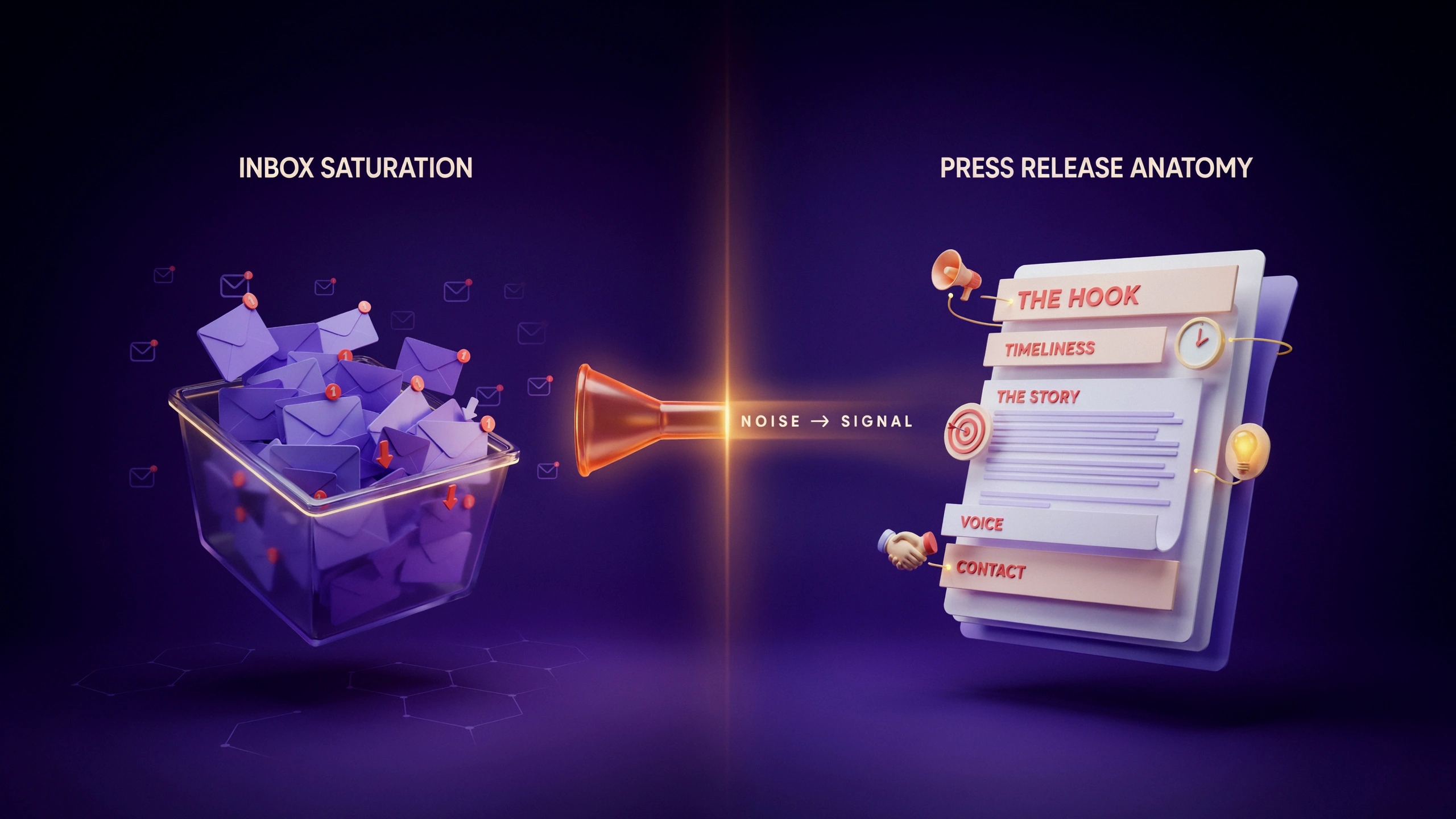
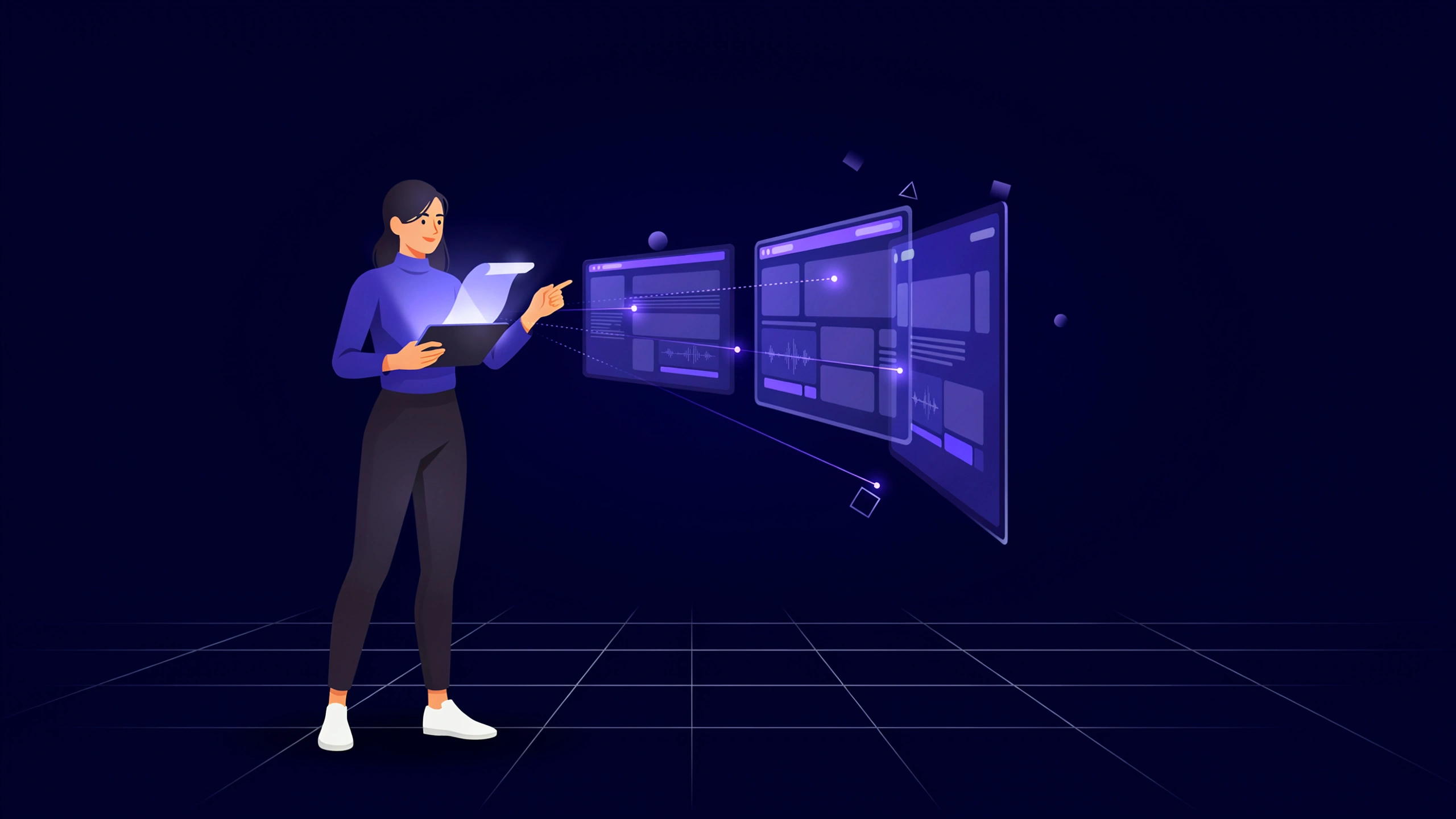
Figure 1: Strategic outreach framework and media targeting workflow.
How to Write a Launch Press Release in 2026: A Step-by-Step Template
The seven anatomy rules are the what. This is the how — a repeatable build sequence you run in this exact order, because each step gates the next. Skip a gate and you're polishing a document that has no destination.
Step 1: Validate the angle against live coverage (before you write a word)
You do not decide what's news. The week's coverage does. Before drafting, scan what journalists are currently publishing in your category — not what your competitors announced last quarter. The test: can you complete the sentence "This matters this week because [live trend a named journalist is actively covering]"? If your launch connects to a wave someone is already surfing, you have a hook. If it connects only to your roadmap, you have a memo.
- Rule of thumb: Identify at least three journalists who published on an adjacent theme in the last 14 days before you commit to the angle. Fewer than three means the wave isn't live — reschedule the launch or sharpen the hook.
- The 2027 shift to prepare for now: As AI-assisted editorial triage accelerates, "why now" windows are compressing. A hook that was fresh on Monday reads stale by Thursday. Build the angle the same week you pitch it, per the accelerating AI adoption documented in the Reuters Institute Digital News Report 2026.
Step 2: Write the headline last (but design it first)
Counterintuitive but non-negotiable: draft the body, then write the headline as the compression of your strongest verifiable fact. A launch headline passes if it survives the "morning meeting" test — could an assignment editor read it aloud and have a producer immediately say "get me that"? Verb-first, number-backed, source-anchored.
| Weak Launch Headline (2026) | Why It Fails | Strong Rewrite | Why It Works |
|---|---|---|---|
| "[Startup] Launches Revolutionary AI Platform" | Adjectives, no fact, no "for whom" | "[Startup] Launches Platform That Cuts Invoice Reconciliation Time 62%, Per [Independent Benchmark]" | Verb-first, named metric, third-party verification |
| "[Company] Raises $12M to Transform [Industry]" | Funding isn't news without a "so what" | "[Company] Raises $12M to Deploy [Specific Product] Across [N] [Named] Customers" | Ties capital to a verifiable deployment |
| "Introducing [Product]: The Future of [Category]" | Zero differentiation, invisible to scan | "[Product] Becomes First [Category] Tool to [Specific Verifiable First], Audited by [Firm]" | Discrete, defensible "first" with an auditor |
| "[Company] Named a Leader in [Space]" | Self-referential, unassignable | "[Company] Data From [N] Users Shows [Counterintuitive Stat] — Challenging [Prevailing Assumption]" | Novel data, editorial tension |
Source basis for the discipline: verifiable statistics and authoritative links measurably increase both human and machine citation, per Princeton University GEO Research, while journalists consistently flag unspecific, self-congratulatory framing as their top frustration, per the Muck Rack State of Journalism report.
Step 3: Build the lead paragraph as a load-bearing unit
Two sentences. First sentence: who, what, why-now, and the exact number — sourced on first mention. Second sentence: the verifiable receipt (named customer, benchmark, auditor, filing). If your first 90 words don't contain a discrete announcement, a named verification, and a "why now," stop and rebuild.
Step 4: Fill the press release template
Here is the 2026 coverage-ready press release template — structure it exactly this way, and keep the body to 350–450 words (journalists scan, they don't read; long releases signal undisciplined thinking):
FOR IMMEDIATE RELEASE  [or: EMBARGOED UNTIL [Date, Time, Timezone]]

[HEADLINE: Verb-first, number-backed, source-anchored]

[SUBHEAD: One line expanding the "for whom" and "verified by what"]

[CITY, State] — [Date] — [Company] today [announced/launched/released] [specific
thing], which [specific verifiable outcome], according to [named third-party
source/benchmark/customer]. [Second sentence: the receipt — named customer quote
or audited figure, sourced on first mention.]

[WHY NOW — 1 short paragraph tying launch to a live trend, citing a named
journalist's recent coverage or an industry data point.]

"[Human quote from named executive — states a defensible position, not
adjectives. Must be attributable and specific.]"
— [Name, Title, Company]

[WHAT IT DOES — 2–3 tight bullets, each a verifiable capability with a metric.]

- [Capability] delivers [metric] for [specific audience], per [source].
- [Capability] is available [date] at [verifiable detail].

"[Optional second quote — customer or independent analyst, ON THE RECORD.]"
— [Name, Title, Organization]

ABOUT [COMPANY]
[Boilerplate: founded year, funding (if public), named customers, cited metrics.
Zero adjectives. Three sentences max.]

MEDIA CONTACT
[Name] | [Verified email] | [Phone] | [Press kit link]
- Rule of thumb: Body 350–450 words; boilerplate ≤3 sentences; zero superlatives ("revolutionary," "seamless," "world-class") — every adjective is a credibility leak.
- Embargo block: If embargoed, state lift date, time, and timezone explicitly in the header. Ambiguous embargoes get ignored or broken.
Step 5: Set embargo and exclusive strategy
Tier-one outlets (the TechCrunch class) treat embargoes as mutual conditions — offer an exclusive or embargo to your top 3 outlets first, with a stated lift time in local zones. Never break your own embargo. One breach converts your next launch's pipeline into a blacklist, a pattern long documented across tech-announcement formatting norms.
- Rule of thumb: Offer exclusives 5–7 business days before lift; embargo the broader list 48–72 hours before lift. Keep a written embargo list — not a memory.
Journalist Discovery, Fit Scoring and Pitch Scripts for 2026-2027
The document is done. Now you find the humans — and in 2026, discovery is a discipline, not a database query. The failure of static media lists is structural: contacts decay the moment they're scraped. Beats rotate, outlets pivot, reporters move. A list pulled six months ago is a bounce farm. This is precisely where real-time discovery via live Google News scanning (as built into Pytch) replaces static records — you surface journalists by what they published this week, then validate delivery before you send.
The journalist vetting criteria (score every contact)
Before a single pitch goes out, score each journalist on five axes. Drop anyone scoring below 3/5:
- Beat match — Do their last 3 published pieces sit directly on your category? (Not adjacent-adjacent. Direct.)
- Recency — Have they published in the last 21 days? A dormant beat is a dead inbox.
- Format fit — Do they write launch/funding/product stories, or only analysis/opinion? Match the format, not just the topic.
- Outlet reach + audience overlap — Does their readership match your buyer? Vanity logos ≠ right audience.
- Verifiability — Can you confirm a currently valid email? Unverified addresses guarantee bounce spirals that damage sender reputation.
Fit scoring: the 2026 weighting model
Assign weights to turn subjective "relevance" into a triage number. This is fit scoring — the difference between a scattergun list and a ranked target sheet.
| Fit Dimension | Weight | Scoring Guide (1–5) | Weighted Max |
|---|---|---|---|
| Beat match | 35% | 5 = exact category, 1 = unrelated | 1.75 |
| Recency (last 21 days) | 25% | 5 = published this week, 1 = dormant | 1.25 |
| Format fit | 20% | 5 = covers launches routinely | 1.00 |
| Audience overlap | 15% | 5 = your buyer reads them | 0.75 |
| Verified contact | 5% | 5 = validated email, 1 = unverified | 0.25 |
| Total | 100% | — | 5.00 |
- Rule of thumb: Pitch only journalists scoring ≥4.0. A tight list of 15–25 high-fit journalists outperforms a 400-address blast — the exact inversion of pre-2024 spray-and-pray logic, and consistent with the personalization-over-volume pattern in AI-assisted pitching analytics tracked at Propel PR.
The pitch email scripts (tested structure)
The pitch is not the release. It is a 90–130 word email whose only job is to earn a click on the release and a reply. Subject line: 6–9 words, no emoji, no ALL-CAPS. Send Tuesday–Thursday, 7–10 a.m. in the journalist's timezone. Follow up once, after 72 hours — never twice.
Script A — The exclusive offer (tier-one target):
Subject: Exclusive: [Counterintuitive Stat] + [Named Customer] on [Trend]
Hi [First Name],
Your piece "[Recent Article Title]" on [specific theme] is the reason I'm writing — my launch lands directly on that thread. We have [Specific Angle]: [one-sentence verifiable claim], backed by [named source/benchmark].
Offering you a 48-hour exclusive ahead of a [Date] lift. Full release + data pack attached. One named independent analyst available on the record for [time window].
Worth 12 minutes this week?
[Name] | [Verified contact]
Script B — The trend-tie pitch (broad tier):
Subject: New data on [live trend you published last week]
Hi [First Name],
You wrote "[Recent Article Title]" last week — our launch adds a data point to exactly that story: [verifiable stat], per [source].
Release embargoe'd until [Date, Time, Timezone]. Happy to send the underlying dataset — no strings.
[Name]
Script C — The follow-up (72 hours, one only):
Subject: Re: [original subject]
Hi [First Name] — bumping once in case it slipped past. The exclusive window closes [Date/Time]. If it's not your beat, no worries — is there a colleague on [theme] I should reach instead?
[Name]
- Rule of thumb: One follow-up, at 72 hours, framed as a gracious out. A second follow-up marks you as spam and poisons a relationship you'll want for launch three.
Hook crafting that survives the scan
The first line of every pitch must prove you read their work — name the article, name the thread, connect your claim. Generic "I loved your recent piece!" is AI noise. Bespoke hooks tied to a reporter's actual last article are exactly what Pytch is built to help you draft, and exactly the relevance signal journalists report rewarding, per the Muck Rack research.
| Approach | Typical Response Profile (2026) | Best For | Structural Weakness |
|---|---|---|---|
| Mass blast to a legacy list | Low-single-digit % response; high bounce | Never recommended | Stale contacts, zero relevance signal |
| Segmented (50–100) static-list send | Modest response, many bounces | Late-stage, low-priority outreach | Decays within weeks of scraping |
| Fit-scored live-discovery (15–25) | Meaningfully higher response + meetings | Tier-one & high-priority launches | Requires weekly re-scanning discipline |
Response patterns aggregated from PR pitching analytics via Propel PR, outlet coverage norms from Cision, and newsroom inbox-saturation context from Pew Research Center Journalism.
Static Media Lists vs. Real-Time AI: A 2026 Pytch Workflow Comparison
The single highest-leverage decision in 2026 journalist outreach is where your contact truth comes from. The old model trusts a database snapshot; the new model trusts this week's published work. The gap is not incremental — it decides between a pitch that lands warm and one that lands in a bounce queue.
The two workflows, side by side
| Workflow Stage | Static Legacy Database (2024-era model) | Real-Time AI Workflow (Pytch, 2026) |
|---|---|---|
| Discovery | Filter a purchased list; contacts may be months stale | Live Google News scanning surfaces journalists publishing your beat this week |
| Relevance signal | Job title + outlet guesswork | Their actual recent articles — the exact thread you hook onto |
| Email validity | Unknown; bounces discovered at send time | Verified email delivery — validated before you send, protecting sender reputation |
| Hook crafting | Generic template, manual guess | Bespoke hook per reporter, tied to their latest coverage |
| Time to warm list | Hours of list-cleaning, still stale | Minutes: scan → score → verify → pitch |
| Failure mode | Silent decay → bounces → blacklist | Weekly re-scan keeps fit scoring current for the 2026–2027 cycle |
The Pytch mini-case: same launch, two pipelines
Scenario: A Series-A fintech launches a reconciliation product. The team has a static list of 180 fintech contacts scraped in the prior year, and a live-scan workflow via Pytch.
- Static pipeline: 180 sends → an estimated large share bounce (editors moved, outlets folded) → sender reputation damaged → a handful of opens, near-zero replies. The list looked like coverage potential; it was a bounce farm.
- Pytch pipeline: Scan Google News for the last 14 days → surface 22 journalists who published on fintech reconciliation, SMB finance, or embedded payments → fit-score them (17 clear ≥4.0) → validate emails for verified delivery → draft a bespoke hook per reporter referencing their actual article → offer a 48-hour exclusive to the top 3 → embargo the rest for a [Date] lift.
💡 The core insight: In 2026 the winning variable is not list size — it's list freshness. Pytch converts discovery from a quarterly list-purchase into a weekly live-scan discipline: scan → fit-score → verify → bespoke hook → pitch → one 72-hour follow-up. That loop is what turns a launch press release into actual media coverage heading into 2027.
Continue to Part 3 for the full 2026 launch checklist, FAQs, measurement benchmarks, and the closing action plan — including how to run your first real-time media search on Pytch.
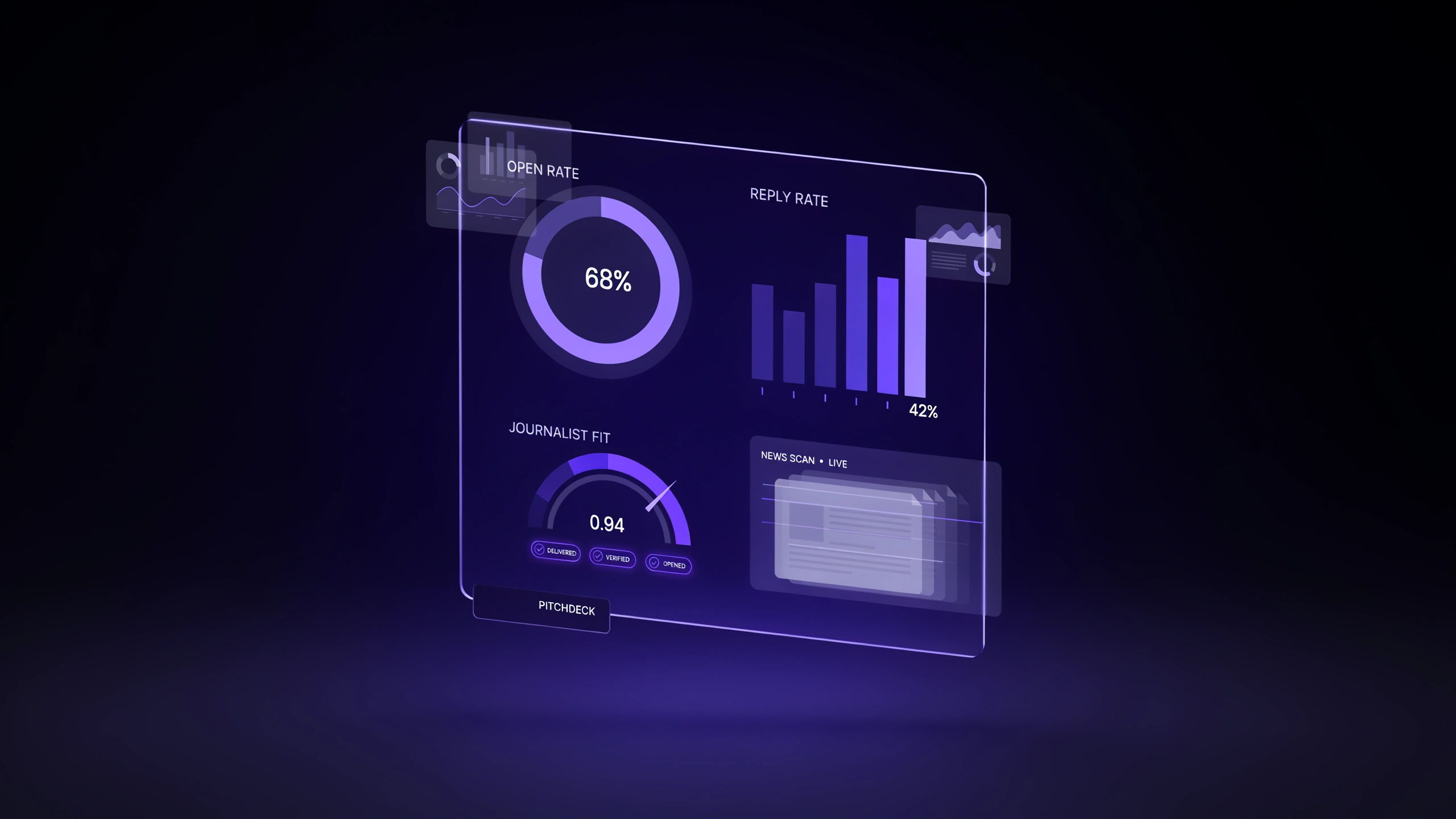
Figure 2: Performance metrics and response tracking across targeted outreach.
The 7 Launch Press Release Mistakes That Kill Coverage in 2026
The difference between a launch that earns a feature and one that earns silence is rarely talent. It is the presence of a small number of specific, diagnosable startup PR mistakes — each of which is fixable before you hit send. Here are the seven failure modes that sank the most launch pitches in 2026, and how to correct each.
Mistake 1: Confusing a product milestone with news
"We shipped v2.0" is a changelog entry, not a story. The most common startup PR mistake is assuming that because you care, an editor will assign. Editors assign change that affects their readers, verified by something outside your company. A feature release must be reframed as a consequence: "v2.0 lets [audience] do [specific thing] in [measurable time], per [benchmark/customer]."
- The fix: Apply the "So what / Who cares / Says who" triad to every claim before it reaches the draft. If any answer is weak, the release isn't ready. This discipline is the same evidence-first framing Harvard Business Review has long documented for executive narratives.
Mistake 2: Sending a broadcast to a stale list
The single most destructive 2026 startup PR mistake is treating a 2024-era media list as a living asset. Contacts decay the moment a beat rotates or an outlet pivots. A blast to 400 scraped addresses doesn't just underperform — the bounces actively damage your sender reputation, which suppresses deliverability on future sends too. This is a compounding liability, not a one-time miss.
- The fix: Replace list-purchasing with a weekly live-scan discipline. Real-time discovery tools built on Google News scanning, like Pytch, surface only journalists publishing this week — turning a static liability into a fresh, warm target sheet every cycle.
Mistake 3: The generic hook that proves you didn't read
"I'm a big fan of your work!" is now indistinguishable from AI noise and is deleted on sight. Journalists consistently rank unspecific, self-congratulatory pitches as their top frustration and report that targeted pitching is itself a trust signal — meaning relevance functions as credibility currency, per the Muck Rack State of Journalism report.
- The fix: Every first line must name the reporter's actual recent article and connect your claim to that specific thread. Bespoke hooks tied to a journalist's last published piece are exactly what Pytch is built to help you draft — and the difference between a reply and a delete.
Mistake 4: Ambiguous or broken embargoes
An embargo that reads "EMBARGOED UNTIL TUESDAY" with no time or timezone is a request to guess — and editors don't guess. Worse, breaking your own embargo once converts your next launch's tier-one pipeline into a blacklist, a norm long codified in tech-announcement formatting at outlets like TechCrunch.
- The fix: State the lift date, exact time, and timezone in the header, keep a written embargo ledger, and never leak early to one outlet while promising another exclusivity.
Mistake 5: Unsourced claims that fail both journalist and machine scrutiny
In 2026 a claim without a receipt is a liability. Journalists screen for verifiability, and — critically — the release now doubles as a source document for AI answer engines. Princeton's generative engine optimization research found verified statistics boost AI citation likelihood by roughly 37%, and authoritative source links by up to 40%, per Princeton University GEO Research. Un-sourced puff copy forfeits both human coverage and downstream AI citations.
- The fix: Attach a named source, benchmark, auditor, or on-the-record customer to every quantitative claim — inside the release body, linked where possible.
Mistake 6: Pitching outside the active news cycle
A perfect pitch sent on a slow Friday afternoon, or two weeks after the trend it references peaked, dies regardless of quality. AI-assisted editorial triage documented in the Reuters Institute Digital News Report 2026 is compressing "why now" windows: a hook fresh on Monday reads stale by Thursday.
- The fix: Send Tuesday–Thursday, 7–10 a.m. in the journalist's timezone, and build the angle the same week you pitch it — not off a deck approved a month ago.
Mistake 7: Treating coverage as a transaction, not a relationship
Founders who vanish after one story, or who send a second aggressive follow-up at hour 96, torch a relationship they'll need for launch three. One gracious follow-up at 72 hours — framed with an easy out — is the ceiling.
💡 The pattern behind all seven: every failure mode is a specificity failure. The launch that earns coverage names its fact, its source, its journalist, and its moment. Everything else is a memo dressed as news.
The 2026 Founder's Launch Press Release Checklist
Print this. Run it in order. Each block gates the next — do not advance until every box is checked. This is the operational launch press release checklist for a 2026 launch that actually earns coverage.
Pre-Launch Prep (T-minus 14 to 5 days)
- Completed the "This matters this week because [live trend]" sentence with a named, actively-covering journalist
- Identified at least 3 journalists who published on an adjacent theme in the last 14 days
- Locked the hard-news angle: what changed, for whom, verified by what
- Drafted body to 350–450 words, boilerplate to ≤3 sentences, zero superlatives
- Headline passes the morning meeting test: verb-first, number-backed, source-anchored
- First 90 words contain a discrete announcement, a named verification, and a "why now"
- Every quantitative claim carries a named source / benchmark / auditor / on-record customer
- Verified statistic linked where possible (boosts AI + human citation per GEO research)
- Named human executive quote — attributable and specific, not adjectives
- Optional customer/analyst quote secured on the record
- Built a press kit: high-res assets, data pack, founder bio, verified media contact
- Embargo/exclusive ledger written down — top-3 tier-one offers drafted, lift time + timezone stated
Outreach Execution (T-minus 7 to lift day)
- Ran a live Google News scan for journalists publishing your beat in the last 14 days (via Pytch)
- Fit-scored every contact on the 5-axis model; dropped anyone below 3/5, pitched only those ≥4.0
- Confirmed verified email validity on every target before sending — zero unverified addresses
- Final list is a tight 15–25 high-fit journalists, not a broadcast
- Offered exclusives to top 3 outlets 5–7 business days before lift
- Embargoed the broader list 48–72 hours before lift
- Drafted a bespoke hook per reporter, naming their actual recent article
- Pitch email is 90–130 words, subject line 6–9 words, no emoji, no ALL-CAPS
- Scheduled sends Tue–Thu, 7–10 a.m. in each journalist's timezone
- Landed the send inside an active news cycle, same week the angle was built
Post-Pitch Nurturing (Lift day to T-plus 30 days)
- Sent exactly one follow-up at 72 hours, framed as a gracious out
- Logged every reply, bounce, and break — no second follow-up, ever
- Delivered promised data packs / analyst access within the stated window
- Tracked coverage against the release's named metrics and cited sources
- Recorded which hooks, subject lines, and send windows earned replies — for launch three
- Re-scanned and re-scored the target list weekly to keep fit scoring current heading into 2027
- Sent a genuine thank-you (not a pitch) to every journalist who engaged
<!-- SEMANTIC_CLUSTER_START -->
Tactical Reference Table
| Scenario | Exact Action / Benchmark | Related Keyword Anchor |
|---|---|---|
| Headline passes scan test | ≤12 words, 1 metric, outcome-first | press release headline and dateline |
| Lede survives standalone read | ≤45 words, answers why-now | product launch press release guide |
| Founder quote is liftable | 1 pain + 1 metric + 1 outcome | founder quote in press release |
| Startup debut release | 2 quotes max, 1 new fact each | writing a startup announcement |
| Boilerplate block | ≤50 words, tracked URL | launch pr boilerplate examples |
| Full architecture check | hook → quote → problem → solution → link | product launch press release guide |
Related Playbooks in the Startup Press & Launch Cluster
Explore connected guides in our Startup Press & Launch semantic cluster:
- Startup Press Release Template: Startup Press Release Template: 5 Formats Tech Reporters Won’t Immediately Delete in 2026
- Product Hunt Launch Checklist: Product Hunt Launch Checklist 2026: From Teaser to #1 Product of the Day
- How To Get Featured In Forbes: How to Get Featured in Forbes: The 2026-2027 Playbook for Founders, PR Pros & Marketing Teams
- Techcrunch Pitch Embargo Rules: PR Embargo Rules Explained: 2026 TechCrunch Pitch Embargo Rules for Tier-1 Exclusives
- How To Announce Funding Round: How to Announce a Funding Round in 2026: Seed & Series A Press Coverage Playbook
Frequently Asked Questions
Q: How long should a launch press release be in 2026?
A 2026 launch press release should run 350–450 words in the body, with a boilerplate of three sentences or fewer. Journalists scan rather than read, and a bloated release signals undisciplined thinking — keep it tight, inverted-pyramid, and scannable.
Supporting detail: length discipline is downstream of the "first 90 words" rule — if the announcement, verification, and "why now" aren't in the opening, no amount of body length rescues the release. Long releases also dilute the machine-readability that drives AI citation, where linked, verified specificity — not volume — earns downstream coverage, per Princeton University GEO Research.
Q: How many journalists should I pitch for a startup launch?
Pitch a tight list of 15–25 high-fit journalists scoring ≥4.0 on the fit model — not hundreds. A small, freshly-scored, relevance-verified list reliably outperforms a large blast, inverting the pre-2024 spray-and-pray logic.
Supporting detail: the supply of pitches has exploded while newsroom capacity has shrunk, meaning editors triage ruthlessly, per Pew Research Center Journalism. Relevance itself is the trust signal journalists reward, per the Muck Rack research, so a small list of provably-relevant, email-verified reporters is worth more than an order of magnitude more stale contacts.
Q: What's the biggest startup PR mistake that kills coverage?
The single biggest startup PR mistake is sending a generic pitch to a stale media list — the bounces damage sender reputation and the irrelevance signals AI spam. Coverage dies not from bad writing but from structural mismatch between a stale contact and a live beat.
Supporting detail: beat rotation and outlet churn mean a list scraped months ago is a bounce farm. The fix is a weekly live-scan discipline — surface journalists by what they published this week, then fit-score, verify emails, and draft a bespoke hook. This is the core workflow Pytch automates, and the reason freshness beats list size in every 2026 benchmark.
Q: How do I write a launch press release that AI search engines will also cite?
Write the release as a machine-readable source document: attach linked, verified statistics and named authoritative sources to every claim. This earns both human media coverage and downstream AI citation — a compounding asset.
Supporting detail: Princeton's GEO research found verified statistics raise AI citation likelihood by roughly 37% and authoritative source links by up to 40% (Princeton University GEO Research). In a 2026-2027 media environment where coverage increasingly lives inside AI Overviews and answer engines, this dual optimization — human trust signals and machine verifiability — is what separates a durable launch asset from a puff release that vanishes.
Conclusion: Turn Your 2026 Launch Into a Measurable Media Moment
The through-line of this entire guide is uncomfortable but liberating: coverage is earned by specificity, not scale. The founders who win launch coverage in 2026-2027 are not the ones with the biggest media lists or the most polished prose. They are the ones who can name one defensible fact, one verifying source, one actively-covering journalist, and one live news cycle — and who respect the discipline of hitting all four at once.
Look back at what actually moved the needle across every section: the hard-news angle validated against this week's coverage; the headline compressed from a verifiable number; the release structured as a document that serves journalists and AI answer engines; the fit-scored list of 15–25 relevance-verified reporters instead of a 400-address blast. None of it is glamorous. All of it is repeatable.
And that repetition is the real asset. A launch is not a single event — it is a system you run again for launch three, four, and five, each time with warmer relationships, sharper hooks, and better data on what your target journalists respond to. The teams that build a weekly live-scan habit — scan, fit-score, verify, hook, pitch, one gracious follow-up — stop gambling on coverage and start engineering it. The teams that keep trusting a static list keep hoping.
💡 The 2027 horizon: As AI-assisted editorial triage compresses "why now" windows and coverage migrates into AI summaries, the winners will be those whose process is real-time and whose document is verifiable. Build both now, and every subsequent launch compounds.
So here is your first move. Before you write another word of your next press release, run a real media search on pytch.cc. Scan live Google News coverage for the journalists publishing your beat this week, validate their emails for verified delivery, and let bespoke hooks tied to their actual recent articles do the work that generic templates never could. You already have the checklist, the template, the fit-scoring model, and the seven failure modes to avoid. What's left is the one action that turns all of it into coverage: go find the humans who are covering your story right now — before you write a single line.
<!-- SEMANTIC_CLUSTER_UPGRADED_V2 -->