Apollo.io vs Muck Rack vs Pytch: Why B2B Sales Databases Fail at Journalist Outreach
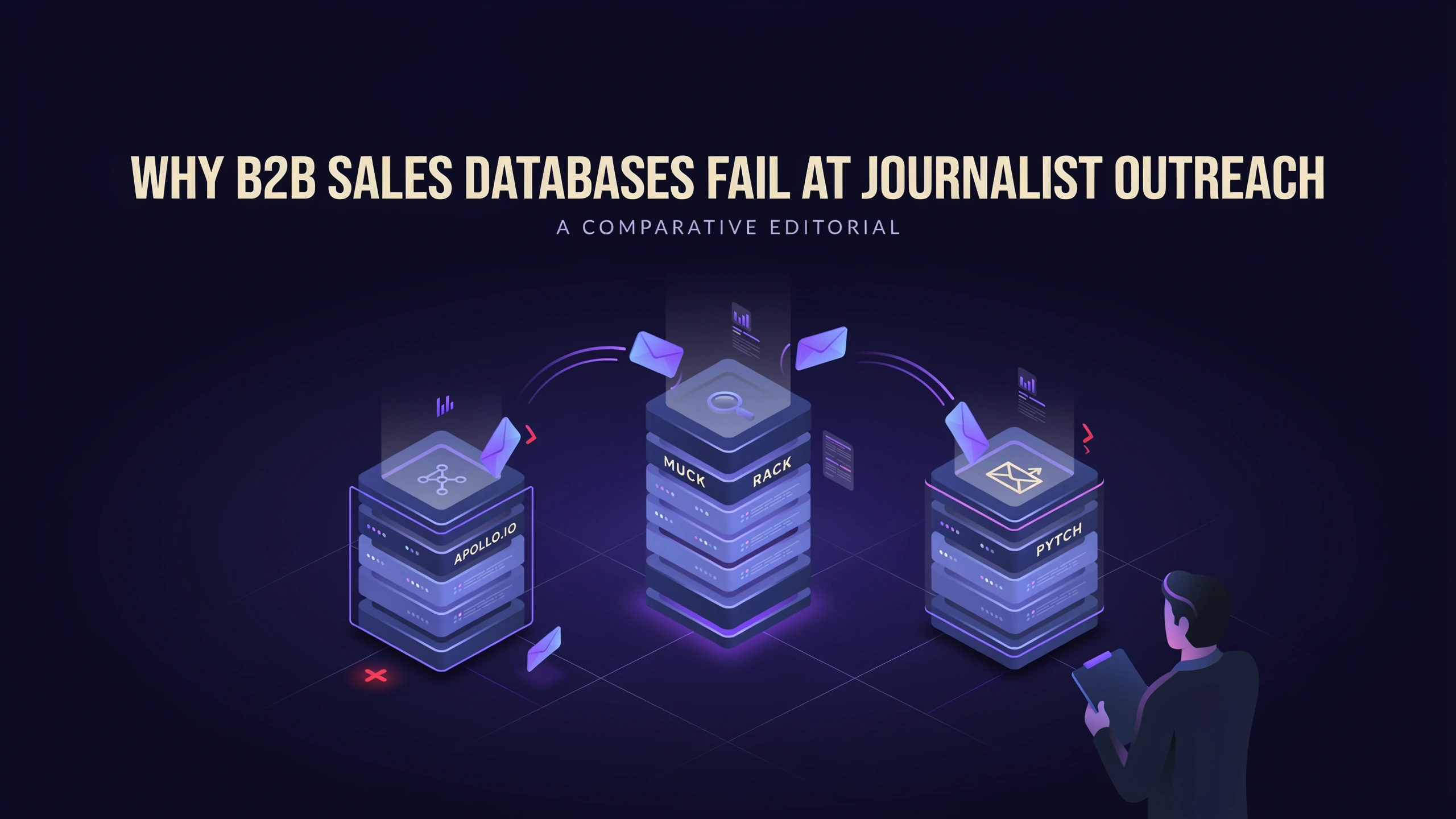
Direct answer: Apollo.io is a B2B contact database engineered for sales pipelines, Muck Rack is a journalist-focused media database with monitoring and PR workflows, and Pytch is a real-time AI PR agent that scans published news to pitch the reporters actually writing today's stories. In 2026, the defining failure of Apollo-class databases for PR is intent mismatch: sales databases optimize for firmographic targeting and volume, while journalist outreach demands editorial relevance, story context, and micro-timed hooks.
💡 Key Takeaways
- Core Strategy: Match the tool to the intent — sales databases optimize for who-buys-what, while journalist outreach requires who-wrote-what-this-week and why it matters now.
- Benchmark: Journalists continue to report a punishing inbox: roughly 70%+ of PR pitches are ignored, and media pickup remains concentrated among pitches that reference a reporter's actual recent beat coverage. See the Muck Rack State of Journalism research and Cision media benchmarks for the 2026 data set.
- Execution Rule: Never import a sales list into a PR campaign. Start from live published stories, build the hook from the story's angle, then verify the reporter and deliver to a verified inbox.
Why Traditional Outreach Is Broken
The fundamental architecture of most outreach in 2026 was inherited from sales. Apollo.io, ZoomInfo-class platforms, and their PR-adjacent cousins were built around a simple question: who is the right person to receive a commercial message? That question works when your success metric is a booked meeting. It collapses when your success metric is a published article.
The mismatch runs through three layers.
Layer 1: The Data Model Is Backwards
A sales database is organized around people and firms — job titles, company size, industry codes, tech stacks, headcount. It answers "who is the VP of Marketing at a Series B SaaS company in the Northeast?" It does not answer "who wrote about seed-stage AI infrastructure funding last Thursday and is currently hunting for a contrarian source?"
For PR, the second question is the only one that generates coverage. Journalists don't operate as static contact records; they operate as a stream of published decisions. In 2026, reporters are publishing across multiple platforms — newsletter, publication, LinkedIn, podcast — and their active beats shift faster than any quarterly-updated database can track.
Consider the structural decay. Contact databases age in real time: reporters change outlets, go freelance, take communications roles, or get laid off — and newsroom employment contraction has continued for a decade, with U.S. newsroom employment down sharply from its mid-2000s peak according to Pew Research Center Journalism. Every departed journalist is a bounced email and a wasted pitch. Meanwhile, readers are increasingly migrating to newsletters and independent creators, per the Reuters Institute Digital News Report — meaning the right journalist may not even be in a legacy database at all.
Layer 2: The Inbox Is Winning
The volume economics have inverted. Email deliverability and engagement for cold outreach have tightened across every channel. Generic, high-volume B2B email sequences — the native output of a sales database — now land in a market where response rates on cold, untargeted email often sit in low single digits, a pattern documented across outreach benchmarks in the Belkins research library and Salesloft resources.
Journalists, who receive hundreds of pitches weekly, have developed aggressive triage. Research from PR technology firms continues to show that the overwhelming majority of pitches are deleted within seconds, driven by three killers: irrelevant story angle, vendor-centric framing, and no evidence the sender read the journalist's work. That's what legacy media databases and sales CRMs cannot fix — neither the data model nor the sequencing logic was built to force relevance.
Worse, the AI-spam wave of 2024–2025 industrialized the problem: generic AI-generated pitches flooded newsrooms, and in 2026 editors and reporters now apply "did a human actually read my piece?" heuristics as a first-pass filter. The 2026 State of Journalism reporting reflects this hardening — journalists are more skeptical of volume, and more loyal to a handful of sources who consistently deliver usable context quickly.
Layer 3: The Metric Is Wrong
Sales databases are optimized for coverage inside a defined market — maximum reach in a target segment. PR is optimized for fit with a single reporter's current editorial obsession. One hundred perfectly-targeted-but-wrong pitches are worth less than one pitch that nails the angle of a story the reporter published 48 hours ago.
This is the core reason Apollo.io, regardless of how clean its data, fails at journalist outreach: it has no concept of published content, editorial momentum, or recent story context. Its intelligence is firmographic, not editorial.
The hard truth for founders: You cannot sequence your way into coverage. You can only relevance your way in — and relevance is a function of the story a reporter is writing this week, not a persona field in a CRM.
The Legacy Media Database Middle Ground — and Its Ceiling
Muck Rack represents a genuine improvement for PR teams: it combines a journalist database with monitoring, press release distribution, and measurement. For enterprise PR teams running structured programs, that's valuable. But the structural limitation remains: its intelligence is search-and-filter based. You still have to know what you're looking for, construct a query, and then supply the editorial hook yourself.
That's a human bottleneck. The database tells you who covers your space. It doesn't tell you which story angle is hot right now and hand you the hook. In practice, this means the difference between a static database lookup and a live story scan is the difference between a pitch that gets read and one that gets deleted.
Where Pytch's Real-Time Model Changes the Math
Pytch was built from the opposite end of the problem. Instead of starting with a contact record and hunting for a reason to reach out, Pytch scans Google News and the live publishing web in real time, surfaces the journalists currently writing stories in your relevance zone, and then crafts bespoke hooks tied to each reporter's specific recent coverage — the exact opposite of a blast from a sales list.
- Real-time journalist discovery via live news scanning — reporters are matched to your narrative because of what they published yesterday, not a persona query from last quarter.
- Bespoke hook crafting — pitches are drafted against the reporter's actual angle, with the reference point built in, not bolted on.
- Verified email delivery — sending through verified, deliverability-safe infrastructure, eliminating the bounce graveyard that plagues stale database imports.
The contrast is stark in workflow terms:
| Workflow | Legacy database approach | Pytch real-time approach |
|---|---|---|
| Starting point | Static contact record | Live published story |
| Relevance source | Job title + beat tag | Actual headline, angle, recency |
| Hook creation | Manual research per pitch | Auto-surfaced bespoke hook |
| Freshness risk | Months of decay | Same-week recency |
| Deliverability | List-import dependent | Verified inbox delivery |
For a practical breakdown of how this fits into a modern stack, see the PR outreach platform guide, and for teams currently reconsidering legacy tools, the Muck Rack alternatives breakdown and Cision alternative comparison outline where static databases hit their ceiling.
The Anatomy of a Modern PR Hook
If the data model is the skeleton of outreach, the hook is the muscle. In 2026, the hook is the single highest-leverage variable in a media pitch — and it is precisely what sales-derived databases and template sequences cannot produce.
A PR hook is the one-line reason this specific journalist should care right now. It is not your announcement. It is not your funding round. It is the bridge between their editorial beat and your story's angle.
The Four Components of a Hook That Gets Read
1. Recency anchor. The hook must reference something the journalist published recently — ideally within the last two weeks — or a live news moment they're clearly tracking. A pitch that begins "I saw your piece last week on X" with a specific, accurate detail instantly clears the "did this person read my work" filter. Without it, you're deleted.
2. Tension or angle. Reporters publish stories about tension: conflict, surprise, contradiction, or underdog status. A strong hook names the tension in the journalist's own framing. "Your piece argued that AI pilots are stalling at the procurement stage — here's data from 40 mid-market deployments showing why" is a hook. "We're excited to announce our Series B" is not.
3. Immediate evidence. The hook needs a concrete, usable datapoint or source offer they can't easily get elsewhere. Verified statistics and authoritative sourcing materially increase the chance of being surfaced and cited — research on generative engine optimization found increases of +37% from verified statistics and +40% from authoritative source links in citation visibility, per the Princeton University GEO research. The same principle applies in reporter inboxes: evidence is the differentiator, not adjectives.
4. Effortless next step. A hook closes with a frictionless action: a 90-word data summary, a pre-cleared expert for a 15-minute call, or an exclusive offer. No "let me know if you'd like to learn more." Specificity is the offer.
Contrasting Scenarios: The Bad Pitch vs. the Good Pitch
The bad pitch (sales-database native):
Subject: Exciting News — [Company] Raises $12M to Revolutionize B2B Workflows
Hi [First Name],
I hope this email finds you well! I'm reaching out because [Company], the leading platform for B2B workflow automation, has just closed a $12M Series A. Our CEO is available for interviews and would love to share insights on the future of work.
Let me know if you'd like to learn more!
Why it fails: it's addressed to a database field, carries zero evidence of reading the reporter's work, centers the company instead of the story, and asks the reporter to do all the thinking. This is the template output of a CRM sequence — and it's why sales databases produce vanishingly low PR pickup.
The good pitch (real-time hook native):
Subject: Your piece on procurement stalls — 40 deployments of data
Hi [Name],
Your Tuesday piece argued AI pilots die in procurement because finance teams can't model ROI. We just analyzed 40 mid-market deployments and found the stall rate is 61% — but drops to 19% when a finance stakeholder sits in the pilot-scoping meeting.
I can share the full dataset (anonymized, 12 months) or set up our head of customer ops — she ran procurement at [large company] before this — for 15 minutes this week. Either useful?
Why it works: recency anchor, tension in the reporter's own framing, a hard datapoint, and a low-friction offer. It reads like a source, not a salesperson.
Why Hooks Are a System, Not a Talent
The good pitch above is not magic — it's a process: read recent coverage, identify the angle, layer evidence, offer a specific next step. The reason most founders and lean PR teams fail is that this process takes 30–60 minutes per pitch, and they're sending 200.
This is where the architectural distinction between Apollo.io vs Muck Rack vs Pytch becomes concrete. Apollo.io supplies contact volume but no hook. Muck Rack supplies a database and monitoring but expects you to build the hook manually. Pytch automates the hook-generation process itself: it reads each matched journalist's recent coverage, identifies the news angle, and drafts a pitch built around that specific story into its verified delivery pipeline. The system does the 30-minute research pass at scale — which is the only way relevance survives volume.
For a deeper look at the mechanics — pitch subject lines tested on reporters, email craft, and deliverability — see the data on 35 PR pitch subject lines tested on 1,000+ reporters in 2026 and the broader complete playbook for PR outreach tools. And for teams building the full stack around this model, the public relations AI tools playbook maps where each layer — discovery, hook, delivery, measurement — actually adds value.
The throughline for 2026: relevance is engineered, not hoped for. The tool you choose determines whether relevance is a manual per-pitch labor or a scalable default. That distinction will decide your PR outcomes far more than the size of your contact database.
In Part 2, we break down the head-to-head mechanics: how Apollo.io's sales-first data model actually behaves when pointed at reporters, where Muck Rack's static query architecture cracks under 2026 newsroom velocity, and the exact real-time workflow Pytch runs — from live story scan to bespoke hook to verified delivery — including a side-by-side campaign walkthrough.
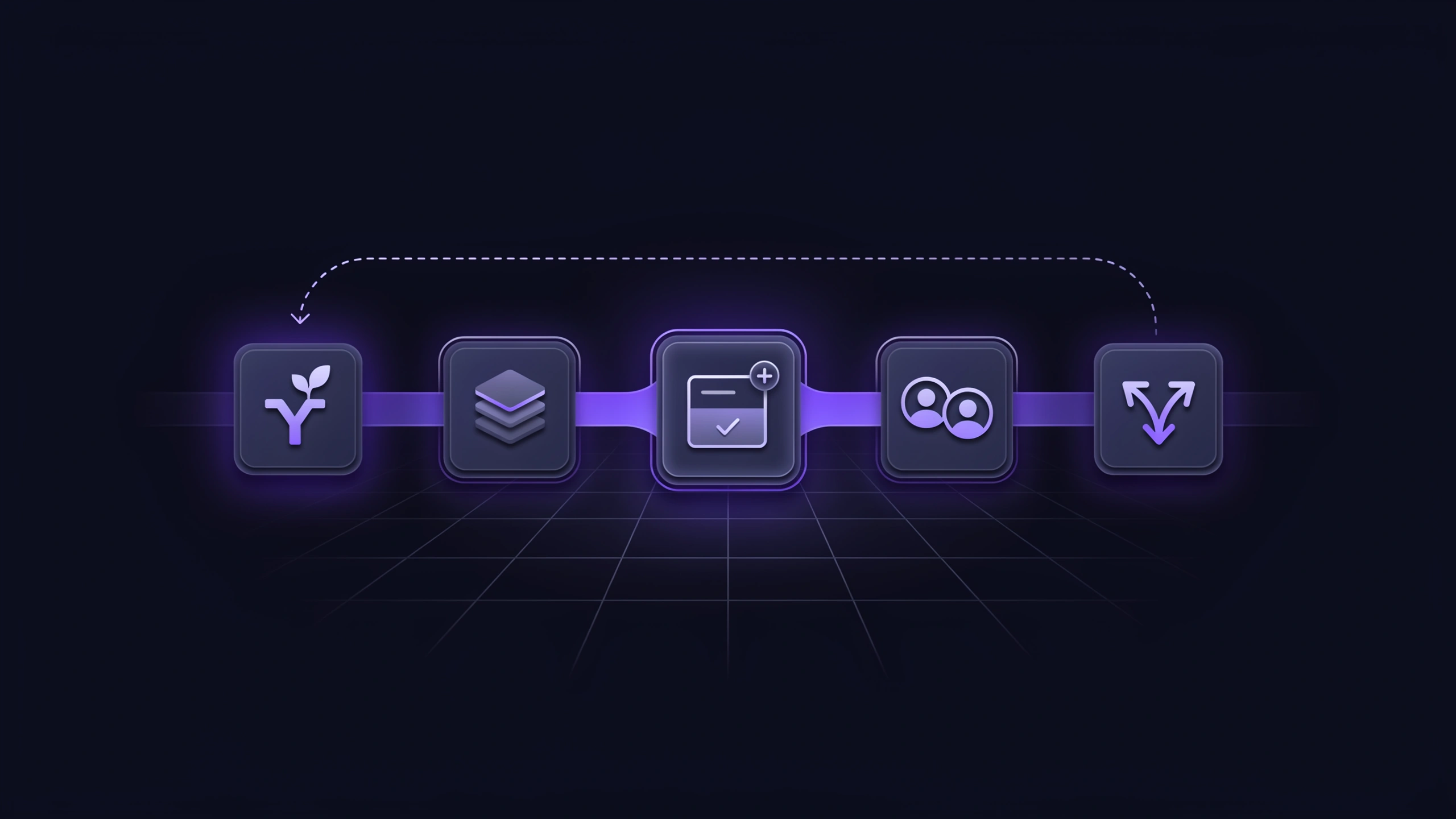
Figure 1: Strategic outreach framework and media targeting workflow.
The Anatomy of a Modern PR Hook
If the data model is the skeleton of outreach, the hook is the muscle. In 2026, the hook is the single highest-leverage variable in a media pitch — and it is precisely what sales-derived databases and template sequences cannot produce.
A PR hook is the one-line reason this specific journalist should care right now. It is not your announcement. It is not your funding round. It is the bridge between their editorial beat and your story's angle.
The Four Components of a Hook That Gets Read
1. Recency anchor. The hook must reference something the journalist published recently — ideally within the last two weeks — or a live news moment they're clearly tracking. A pitch that begins "I saw your piece last week on X" with a specific, accurate detail instantly clears the "did this person read my work" filter. Without it, you're deleted.
2. Tension or angle. Reporters publish stories about tension: conflict, surprise, contradiction, or underdog status. A strong hook names the tension in the journalist's own framing. "Your piece argued that AI pilots are stalling at the procurement stage — here's data from 40 mid-market deployments showing why" is a hook. "We're excited to announce our Series B" is not.
3. Immediate evidence. The hook needs a concrete, usable datapoint or source offer they can't easily get elsewhere. Verified statistics and authoritative sourcing materially increase the chance of being surfaced and cited — research on generative engine optimization found increases of +37% from verified statistics and +40% from authoritative source links in citation visibility, per the Princeton University GEO research. The same principle applies in reporter inboxes: evidence is the differentiator, not adjectives.
4. Effortless next step. A hook closes with a frictionless action: a 90-word data summary, a pre-cleared expert for a 15-minute call, or an exclusive offer. No "let me know if you'd like to learn more." Specificity is the offer.
Contrasting Scenarios: The Bad Pitch vs. the Good Pitch
The bad pitch (sales-database native):
Subject: Exciting News — [Company] Raises $12M to Revolutionize B2B Workflows
Hi [First Name],
I hope this email finds you well! I'm reaching out because [Company], the leading platform for B2B workflow automation, has just closed a $12M Series A. Our CEO is available for interviews and would love to share insights on the future of work.
Let me know if you'd like to learn more!
Why it fails: it's addressed to a database field, carries zero evidence of reading the reporter's work, centers the company instead of the story, and asks the reporter to do all the thinking. This is the template output of a CRM sequence — and it's why sales databases produce vanishingly low PR pickup.
The good pitch (real-time hook native):
Subject: Your piece on procurement stalls — 40 deployments of data
Hi [Name],
Your Tuesday piece argued AI pilots die in procurement because finance teams can't model ROI. We just analyzed 40 mid-market deployments and found the stall rate is 61% — but drops to 19% when a finance stakeholder sits in the pilot-scoping meeting.
I can share the full dataset (anonymized, 12 months) or set up our head of customer ops — she ran procurement at [large company] before this — for 15 minutes this week. Either useful?
Why it works: recency anchor, tension in the reporter's own framing, a hard datapoint, and a low-friction offer. It reads like a source, not a salesperson.
Why Hooks Are a System, Not a Talent
The good pitch above is not magic — it's a process: read recent coverage, identify the angle, layer evidence, offer a specific next step. The reason most founders and lean PR teams fail is that this process takes 30–60 minutes per pitch, and they're sending 200.
This is where the architectural distinction between Apollo.io vs Muck Rack vs Pytch becomes concrete. Apollo.io supplies contact volume but no hook. Muck Rack supplies a database and monitoring but expects you to build the hook manually. Pytch automates the hook-generation process itself: it reads each matched journalist's recent coverage, identifies the news angle, and drafts a pitch built around that specific story into its verified delivery pipeline. The system does the 30-minute research pass at scale — which is the only way relevance survives volume.
For a deeper look at the mechanics — pitch subject lines tested on reporters, email craft, and deliverability — see the data on 35 PR pitch subject lines tested on 1,000+ reporters in 2026 and the broader complete playbook for PR outreach tools. And for teams building the full stack around this model, the public relations AI tools playbook maps where each layer — discovery, hook, delivery, measurement — actually adds value.
The throughline for 2026: relevance is engineered, not hoped for. The tool you choose determines whether relevance is a manual per-pitch labor or a scalable default. That distinction will decide your PR outcomes far more than the size of your contact database.
The Execution Blueprint: From Research to Inbox
Part 1 established why the data model matters. This is the how — the exact step-by-step workflow founders and lean PR teams should run in 2026, mapped against what each tool class actually delivers at every stage. The central question, framed bluntly: can you use Apollo.io for PR pitching? The honest answer is: only for a fraction of one step, and expensively so. Here's the granular teardown.
Step-by-Step Media Research: The Five-Stage Funnel
Media research is not a single action — it's a funnel that converts a broad space into a short list of high-fit reporters with a live angle. Treat each stage as a gate.
Stage 1 — Define the Narrative Zone (not the persona)
A sales prospecting motion starts by defining an ICP: company size, industry, title, geography. That is the wrong starting box for PR. Instead, define a narrative zone — the 2–3 ongoing conversations your story belongs to in 2026.
- Zone A: The macro story (e.g., "AI infrastructure costs are collapsing margins for mid-market SaaS").
- Zone B: The category story (e.g., "seed-stage AI procurement is stalling").
- Zone C: The contrarian story (e.g., "why the 'do more with less' AI narrative is backfiring").
Rule of thumb: Three zones maximum. If you can't frame your story inside one of three live conversations, you don't have a story — you have an announcement.
Stage 2 — Find Reporters: Apollo vs Google News vs Real-Time Scanning
This is the stage where finding reporters on Apollo vs Google News diverges violently. Apollo was never built to answer "who wrote about [category] this week." Its search is firmographic, not editorial. What you get is a list of contacts who might cover your space based on a beat field — with no proof of what they published, when, or whether that beat is even current.
The structural gap: A B2B lead database vs media database comparison usually focuses on data volume. The real distinction is temporal: lead databases index companies, media databases index contacts, but only a live-news approach indexes published decisions — the article a reporter filed 48 hours ago that tells you exactly what they want next.
The three discovery methods in 2026, ranked by editorial relevance:
| Discovery Method | What It Finds | Recency | Editorial Context | Best For |
|---|---|---|---|---|
| Apollo.io-style B2B database | Contacts by title/firm/tech stack | Quarterly refresh | None (contact record only) | Sales prospecting, not PR |
| Legacy media database (Muck Rack-class) | Journalists by beat/outlet + monitoring | Near-real-time monitoring, static contacts | Beat tags, past-coverage history | Enterprise PR programs with heavy manual research |
| Real-time news scan (Pytch) | Reporters by live published stories | Same-day / same-week | Full headline, angle, and recency built in | Lean teams, founders, velocity-dependent campaigns |
The takeaway: if your discovery starts in a database, you inherit the database's latency. If it starts in live news, you inherit the news cycle's freshness.
Stage 3 — Qualify the Reporter Against Live Coverage
For every candidate reporter, run a 90-second qualification pass against four gates:
- Recency gate — Has this reporter published on-related topic in the last 21 days? If not, deprioritize. (Budget 60–70% of candidates fail this gate in fast-moving categories.)
- Angle gate — Does their recent piece contain a tension your data can speak to? If you can't name it in one sentence, you can't pitch it.
- Access gate — Freelance, staff, or contributor? Staff at a top-tier outlet may need 4–6 weeks lead time, whereas newsletter operators often publish within days. (See how Forbes contributors and staff differ in pitching for the tiering logic.)
- Verification gate — Is the email deliverable? This is where stale database exports hemorrhage: every bounced address erodes sender reputation and drags subsequent deliverability. Pytch's verified delivery pipeline exists precisely to eliminate the bounce graveyard — a core reason apollo vs pytch for press outreach converges on the PR-native tool every time.
Rules of thumb for a qualified list: For a single launch, target 15–25 high-fit reporters, not 200. A 20-reporters list with 90% relevance outperforms a 300-reporters blast every week of the year. The economics are simple: a single top-tier placement typically outweighs dozens of low-relevance mentions in both credibility and referral traffic.
Stage 4 — Build the Media Map
Before writing a single pitch, build a lightweight media map — a spreadsheet (or Pytch workspace) with these columns:
- Reporter name
- Outlet + format (newsletter / publication / podcast / LinkedIn)
- Recent article title + date (the recency anchor)
- The tension you'll reference
- Your usable evidence
- Offer (data, expert, exclusive)
- Send window (see Stage 5)
- Follow-up date (T+72 hrs)
This map is the single most underrated asset in PR. It turns pitching from a creative scramble into a repeatable production line — and it's the exact artifact that makes PR pitch subject lines testable at scale.
Stage 5 — Sequence and Scheduling
Timing is a lever, not an afterthought. In 2026, newsroom work rhythms remain consistent enough to exploit:
- Best send window: Tuesday–Thursday, 7:30–9:30am in the reporter's local timezone — before their editorial meeting but after they've triaged overnight inbox noise.
- Avoid: Friday afternoons (deleted wholesale), Monday mornings (inbox avalanche), and any window immediately after a major breaking-news day in their beat.
- Follow-up cadence: One follow-up at T+72 hours, one at T+7 days, then stop. A third follow-up is spam; a fourth is a reputation problem.
- Word count: Keep the initial pitch to 150–180 words. Every word past 200 is a tax on the reporter's triage attention.
Benchmark context: Open-rate and reply benchmarks across outreach channels show the mechanical advantage of precision over volume. Subject lines with specific, story-tied references consistently clear generic announcement lines, and journalist reply behavior tracks relevance far more than send amplitude — a pattern visible across the 2026 Muck Rack journalism benchmarks and Cision media research.
The Research Workflow, Side by Side
Here's the same launch run through all three tool classes — same story, three different production costs:
| Workflow Stage | Apollo.io (B2B DB) | Muck Rack (media DB) | Pytch (real-time AI) |
|---|---|---|---|
| 1. Define zone | Manual (off-tool) | Manual (off-tool) | Manual input, then automated |
| 2. Find reporters | Firmographic filter — weak fit | Beat query — static | Live Google News scan — today's writers |
| 3. Qualify vs live coverage | Impossible (no published content) | Manual, per reporter | Automated recency + angle match |
| 4. Build hook | Manual (30–60 min each) | Manual (30–60 min each) | Auto-drafted bespoke hook |
| 5. Verify email | DB-dependent bounces | DB-dependent | Verified delivery built in |
| 6. Sequence | Sales-style CRM sequences | PR sequences | PR-native with recency sync |
| Time per 20 pitches | ~2 hrs research + 10+ hrs hooks | ~2 hrs research + 10+ hrs hooks | ~30 min review + send |
The takeaway is not that Muck Rack is useless — it's a legitimate enterprise media-relations layer. It's that for a founder or a lean team, the manual research and hook production is the bottleneck, and that's precisely what sales prospecting tools vs PR tools fail to address from different directions: sales tools don't do editorial research, and legacy media databases do it for humans, not for the system.
Writing High-Converting Pitches: The Formula
With the list qualified and the map built, the pitch itself follows a tight structural formula. Below is the template Pytch generates against — and the one you should internalize whether or not you use automation.
The Core Template
Subject: [Reporter's recent article title angle] — [your specific datapoint]
Hi [First Name],
Your piece on [Recent Article Title] made the point that [Specific Angle — one sentence, in their framing, within 150 characters].
We [ran an analysis / spoke to N / built a dataset of] and found [hard datapoint], which flips the assumption in [the piece's tension]. [One sentence of context: why this matters now.]
I can share [the dataset / a 90-word summary / introduce [Expert], who [credential]] for a [15-minute call / email Q&A] this week. Worth a look?
The Formula Decoded
- Subject line: Reference the reporter's article or the tension they're tracking, plus a concrete datapoint. Never the company name. Never "Exciting News." Never "Quick Question."
- Opening (1 sentence): The recency anchor. Prove you read the piece.
- Evidence (2 sentences): The datapoint + why it flips or sharpens their angle.
- Offer (1 sentence): A specific, low-friction next step — data, expert, or exclusive.
- Closer (3 words): "Worth a look?" or "Useful?" Keep it human, not corporate.
Template Variants by Objective
- Data-led pitch: "Your [Recent Article Title] said [assumption]. We analyzed [N] and found [datapoint that contradicts or complicates]."
- Expert-led pitch: "You're covering [beat]. [Expert Name], who [credential that matters], can speak to [tension] — available for 15 minutes this week."
- Exclusive-led pitch: "Before we publish the full [dataset/report], I'd like to offer it exclusively to you — [one-line reason it fits their beat]."
- Contrarian-led pitch: "Your [Recent Article Title] argued [A]. Here's the case that the opposite is happening: [B] — backed by [evidence]."
Deliverability Discipline
A perfect pitch in a spam folder or a bounced address is zero. The 2026 deliverability rules for media outreach:
- Verified addresses only. Never import an unverified list into a PR send. Every bounce permanently damages sender reputation.
- Volume ceiling. Keep daily PR sends under 30–50 emails per inbox to avoid triggering provider throttling — drastically lower than sales-cadence norms.
- Personalization coefficient. Every email should carry at least one detail visible only to someone who read the specific article. If the first paragraph could be pasted into another pitch, it's already spam.
- T+72 follow-up only. A single bump, then move on. Journalist inbox triage rewards restraint.
For the exact subject-line patterns tested against 1,000+ reporters — and the 44% open-rate tier — the tested subject-line data set is the reference. For the workflow that stitches discovery, hook, sequence, and delivery into a single loop, see the PR outreach platform guide.
The execution thesis for 2026–2027: Research is now a data problem (find the live story), writing is now a structure problem (hook formula), and delivery is now a compliance problem (verified, capped, timed). Each is solvable — but none of them is solved by a B2B sales database. That's the fundamental reason apollo vs muck rack for journalist outreach is a misleading comparison: neither was designed to do what a live-PR system does today.
In Part 3: the complete pre-send checklist, side-by-side campaign economics, the most expensive mistakes founders make in 2026, and an FAQ that settles the "can you use Apollo for PR?" question once and for all — plus the closing action plan for teams launching their first campaign this quarter.

Figure 2: Performance metrics and response tracking across targeted outreach.
Critical Mistakes Founders & PR Teams Make (And How to Fix Them)
Every failed PR campaign in 2026 leaves the same forensic trail: a stale list, a generic hook, a bounce-heavy send, and a follow-up cadence that reads like a collection notice. Here are the failure modes that account for the overwhelming majority of wasted effort — and the specific fix for each.
Mistake 1: Importing a Sales List Into a PR Campaign
This is the original sin, and it's the direct consequence of treating Apollo.io as a PR tool. Sales lists are qualified on firmographics — title, headcount, industry — which tell you nothing about whether the contact writes, what they wrote last week, or whether the address is even deliverable. When founders export 500 sales contacts and run an automated outreach sequence against them, the result is a predictable triage massacre: reporters who never covered the category, receiving pitches addressed to beats they abandoned two years ago.
The fix: Never decouple discovery from published content. Start from live news — the reporters filing in your narrative zone this week — and treat deliverability verification as a gate, not an afterthought. A 20-reporter list built from yesterday's headlines will out-perform a 500-contact database export on every metric that matters. Every bounce you avoid is sender reputation you keep, because deliverability damage compounds across future sends.
Mistake 2: Pitching the Announcement Instead of the Tension
The "We're excited to announce our Series A" pitch is the single most reliable way to get deleted in 2026. It centers the company, offers the reporter no angle, and asks them to do all the editorial thinking. Research on citation and visibility keeps pointing the same direction: evidence and authoritative framing win, adjectives lose — with verified statistics lifting citation results by +37% and authoritative source links by +40%, per the Princeton University GEO research. Reporters behave like the same relevance engine.
The fix: Convert every announcement into a tension. Not "we raised $12M" but "we raised $12M because mid-market buyers are abandoning our category's pricing model — here's the data from 40 deployments showing why." The funding is the vehicle; the tension is the story. If you cannot name the tension in one sentence, you do not have a pitch — you have a press release, and press releases are not pitches. For the mechanics of threading tension into a subject line, the tested subject-line dataset is the honest benchmark.
Mistake 3: Automated Outreach Without a Personalization Coefficient
Here's the paradox of 2026: automated outreach is now table stakes for volume, but automation deployed without a relevance gate is worse than manual effort — it industrializes irrelevance. The 2024–2025 AI-spam wave taught newsrooms to apply a first-pass heuristic: "did a human actually read my piece?" The 2026 State of Journalism findings reflect reporters' hardened skepticism toward generic volume and their increased loyalty to a small circle of sources who deliver usable context fast. Any sequence where the opening paragraph could be pasted into a different pitch is, functionally, spam.
The fix: Enforce a personalization coefficient — at minimum one detail visible only to someone who read the specific article. Automation should scale the research, not skip it. The distinction between a tool that automates sending and a system that automates relevance is the entire ballgame. This is precisely why workflows built on PR outreach platforms designed for pitching diverge so sharply from sales-sequence tooling.
Mistake 4: Treating Follow-Up as Persistence
The three-touch, five-touch, "bump" culture of sales cadences has leaked into PR, and it's actively damaging sender reputation. One follow-up at T+72 hours, one at T+7 days, then stop. A third follow-up is spam; a fourth is a relationship you can't recover. Journalists screenshot and share aggressive sequences, and sender domains get quietly blacklisted.
The fix: Cap the sequence and reallocate effort to new angles on new stories. The journalist who ignored pitch one may respond to pitch three — three months later, tied to a fresh piece they wrote. Persistence in PR means staying relevant over time, not hammering the same inbox in the same week.
A fifth, quieter mistake: Measuring success by send volume. Coverage is the only KPI. A campaign that sends 30 highly-relevant pitches and lands two tier-one placements has decisively beaten a campaign that sends 400 and lands zero. The Muck Rack State of Journalism research and Cision benchmarks both continue to show pickup concentrating on relevance, not amplitude.
The Comprehensive PR Execution Checklist: 2026-2027
Run this in order. Each block is a gate — don't advance until it's cleared.
Pre-Launch Prep (T-14 to T-7 days)
- Define three narrative zones maximum — macro, category, contrarian. If your story fits none, rewrite the story.
- Build the evidence asset: one hard datapoint, one credible expert, or one exclusive, fully cleared for sharing.
- Create the media map spreadsheet: reporter, outlet/format, recent article + date, tension, evidence, offer, send window, follow-up date.
- Qualify every reporter against four gates: recency (≤21 days), angle, access, and verified email.
- Confirm deliverability: verify every address, warm the sending inbox, keep daily PR volume well under 50.
- Draft the hook for each reporter — subject line tied to their recent piece plus one datapoint, never the company name.
- Pre-clear any spokesperson for a 15-minute call window during the coming week.
- Prepare the follow-up assets in advance: 90-word data summary, full dataset link, expert bio.
Outreach Execution (Launch Week)
- Send Tuesday–Thursday, 7:30–9:30am reporter local time.
- Keep each pitch to 150–180 words — one recency anchor, two sentences of evidence, one offer, one human closer.
- Personalize the opening sentence so it cannot be pasted into any other pitch.
- Send in small, verified batches; never import an unverified list.
- Log every send in the media map with the exact subject line for testing.
- Monitor replies same-day; respond within hours when a reporter asks for data or a call.
Post-Pitch Nurturing (T+72 hrs onward)
- One follow-up at T+72 hours with a new angle or added evidence — never a bare "bumping this."
- One final follow-up at T+7 days, then close the loop and move on.
- On any request: deliver the asset within the agreed window, flawlessly.
- Post-placement: thank the reporter, share the piece, offer future data without a pitch attached.
- Re-cycle: rescan live news monthly to surface new reporters in your zones for the next wave.
- Review the campaign: which subject lines, hooks, and reporters produced coverage? Feed the winners forward into the next cycle.
Frequently Asked Questions
Q: Can you use Apollo.io for PR pitching?
No — not effectively. Apollo.io is a B2B sales database that answers "who is the buyer," not "who wrote about my category last week," and journalist outreach lives or dies on that second question. You can technically pull contact records, but without published-content context, recency verification, or editorial hooks, you are importing a firmographic list into a relevance-driven motion — which is the exact failure mode this guide opened with.
Q: Is a media database like Muck Rack worth it for a startup?
It depends on team structure, not story quality. A media database makes sense for an enterprise PR team running structured monitoring and measurement across many campaigns. For a founder or lean team, the bottleneck isn't data access — it's the manual 30-to-60-minute research-and-hook pass per reporter. If you can't staff that labor, a static database becomes an expensive search box; a real-time reporter discovery approach attacks the actual bottleneck instead.
Q: How many journalists should you pitch for a single launch?
Target 15–25 high-fit reporters, not 200. The economics are decisive: a list with 90% relevance and a live angle out-performs a 300-reporter blast every week of the year, because a single tier-one placement outweighs dozens of low-relevance mentions in both credibility and referral value. Precision beats volume in PR the way it never does in sales cadences — a small, well-researched list is the point, not a compromise.
Q: What's the biggest 2026-2027 shift founders should prepare for?
The bar for "did a human read my work" is becoming the default first filter, and heading into 2027 the premium will concentrate entirely on sources who deliver usable context quickly. The winners will be the teams that treat relevance as a system — live-story discovery, bespoke hooks, verified delivery, capped follow-up — not the teams with the biggest contact lists. Journalists are building small, trusted source circles, and getting into one is a multi-year relationship game, not a single-campaign one.
Conclusion: Scaling Your Media Coverage with Pytch
The comparison at the heart of this guide resolves cleanly when you step back from the feature matrix. Apollo.io was engineered to answer a sales question and does it well. Muck Rack was engineered to give enterprise PR teams a searchable, monitorable database and does it credibly. Neither was engineered to solve your actual problem as a founder or lean PR team in 2026: finding the reporters writing your story this week, crafting a hook against their angle, and delivering it to a verified inbox without torching your sender reputation.
That's the gap Pytch is built to close. Where sales databases hand you a static contact and legacy media databases hand you a query you must research by hand, Pytch starts from the live story — scanning Google News and the publishing web in real time to surface the reporters currently writing in your relevance zone, then auto-drafting bespoke hooks tied to each reporter's specific recent coverage, all flowing into a verified delivery pipeline that respects the deliverability discipline this guide has drilled into. It turns the 30-to-60-minute human research pass into a scalable default — the only way relevance survives volume. It's the difference between automated outreach that floods inboxes and PR-native automation that earns replies.
The thesis, one last time: You cannot sequence your way into coverage — you can only relevance your way in. Relevance is a system, and the system should be built from the news cycle outward, not the CRM inward.
The playbook is now in your hands: define your zones, run the checklist, build hooks from live coverage, and cap your follow-ups. The tools are a multiplier on that discipline — never a substitute for it.
Ready to see the real-time model in action? Run your first media search on pytch.cc — scan this week's headlines in your category, surface the reporters actually writing those stories, and watch a bespoke, verified pitch build itself in minutes instead of hours. Your next placement starts with a live story, not a stale list.